California Is Discriminating Against Religious Homeschool Families
John and Breanna Woolard’s Christian faith is central to who they are, and they want to ensure their children receive an education grounded in those beliefs. That’s why they chose to teach them at home.
California offers a program to assist homeschool families. But the state rejects any work the kids turn in that even mentions faith. . A federal appeals court essentially declared their kitchen table a “public school.”
First Liberty has asked the U.S. Supreme Court to hear their case. The outcome won’t just impact families in California. It could set a precedent that protects the right of every parent to choose the best education for their children.
Watch John and Breanna’s story:
 Making Military Chaplains Great Again
Secretary of War Pete Hegseth announced the creation of an Office of Religious Affairs (ORA) “to strengthen the moral, ethical and spiritual readiness of our warfighters.” The director will report directly to Hegseth.
A Department of War memo explained the agency “will ensure resources are adequately provided and, where necessary, policy is properly aligned to prioritize the free exercise of religion and the spiritual readiness across the Total Force.”
Hegseth made the announcement during his “State of the Force” speech on Sept. 30.
“We are placing spiritual health at the same level as physical health,” Hegseth said. “Our department is, you might say, is putting on the full Armor of God. Because while we wage physical war, we all know the real battle is spiritual. God is good. Evil is not. America’s military must understand the difference.”
According to Hegseth, one of the main objectives is to provide military chaplains proper support to carry out their duty.
“This won’t be a paper-pushing shop,” he explained. “It will have real teeth. It will protect budgets, demand infrastructure, and strengthen religious support. The experts, our chaplains, will finally have an advocate at the highest levels. Policy and resources will serve the mission, not smother the mission.”
The ORA is the latest in a long list of positive steps by the administration that will protect religious liberty for our service members, chaplains and veterans.
In January, the President’s Religious Liberty Commission heard testimony about the attacks on religious freedom in the military. The Commission heard from First Liberty clients and attorneys who experienced religious discrimination.
“Religious liberty is a very foundation stone of American security,” explains First Liberty Senior Counsel and Director of Military Affairs, Chris Motz. “Throughout its history, faith has been the sinew binding America’s might. In recent memory, this pillar vanished. Outright religious discrimination in the armed forces has been well-documented.”
Religious liberty is in the DNA of America’s military. Faith has played a central role throughout our nation’s history, back to the Founding Era when George Washington requested chaplains to support the Continental Army in the fight for independence.
A congressional report found approximately 73% of service members identify as people of faith, and they attend religious services weekly or more at twice the rate as their civilian counterparts. The men and women in uniform continue to draw strength, courage and inspiration from their faith as they fight for the rights and freedoms that we cherish so dearly.
Our mission at First Liberty is to fight for those who fight for us. We are the first line of defense when service members are targeted for the very faith that inspires them to safeguard our freedoms.
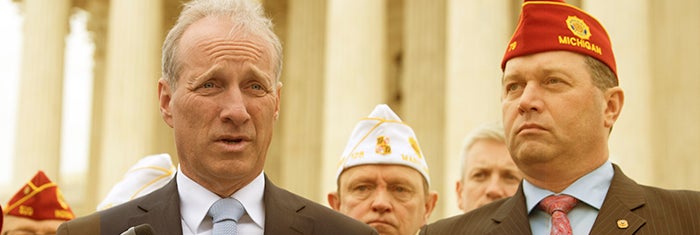
First Liberty has two cases that will be heard this winter and seven additional case requests pending. Fighting at the Supreme Court costs First Liberty millions of dollars. So, we’re launching a Supreme Court Defense Fund to help us reach new heights.
Will you join with us and give to this Fund? Stand with First Liberty’s clients by donating today.
Leading The Conversation
Catholic Shrine Case Pits Religious Rights Against Zoning Laws – Senior Counsel Ryan Gardner | WORLD
Video | Fired After Refusing COVID Shot – Now She’s Getting $200K – Senior Counsel Cliff Martin | One American News Network
Secretary Pete Hegseth Wants Religious Faith ‘Front and Center’ in the U.S. Military – Associate Counsel Erin Smith | Deseret News
Two Trump VPs, Two Visions – Center for Religion, Culture & Democracy Senior Fellow Hunter Baker | Public Discourse
Recovering Fusionism – Center for Religion, Culture & Democracy Research Fellow Paul Mueller | Civitas Outlook
 He Died with Nothing — Because He Gave Everything
by Mike Berry, Executive Director of External Affairs & Senior Counsel
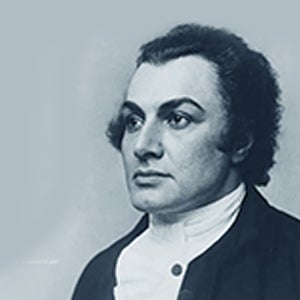
Haym Salomon was a man history has often forgotten. His name is not among those learned in history classrooms across America. When he died at just 44 years of age in 1785, Salomon was destitute. But Haym Salomon was not a failure. His young family was left with nothing because he gave everything for the cause of liberty.
Salomon is often remembered as the Jewish patriot and financier who helped sustain the American Revolution. That is an important part of his story. Indeed, Washington’s successful campaign at the pivotal Battle of Yorktown would have been a spectacular failure had it not been for Salomon’s financial provision. But his deeper legacy lies in the connection between his support for independence and his later advocacy for religious liberty.
He understood something essential about the American experiment: political independence meant little if Americans remained divided into classes of citizens based on their religious beliefs.
Salomon believed wholeheartedly in the American idea, and he became deeply involved in the patriot cause. The British repeatedly captured and imprisoned him, even sentencing him to death at one point. But he escaped and eventually established himself in Philadelphia.
There, he became a successful financial broker and worked closely with Robert Morris, the Superintendent of Finance of the Continental Congress.
At a moment when the fledgling Continental government desperately needed money and credit, Salomon repeatedly put his own resources and financial standing at risk. His contributions helped provide the funds necessary to sustain the war effort.
The Revolution, however, required more than money.
It also required a vision of what kind of country Americans were trying to create.
For Salomon, that question became intensely personal after the war. Pennsylvania’s 1776 Constitution contained a religious oath requirement for public office. The oath requirement was designed to disenfranchise Pennsylvania’s Quaker majority—Quakers object to taking any oaths. But the requirement also effectively excluded Jews from public office. This created a striking contradiction.
The very patriot who had helped finance a revolution in the name of liberty was excluded from full participation in political life because of his religious convictions.
So Haym Salomon did what he had always done: He acted.
In 1783, he and other Jewish leaders successful petitioned Pennsylvania to remove the religious restriction. He insisted that the liberty he had helped purchase must include religious liberty.
But Salomon’s legacy also reveals another equally important lesson. He did not demand that the government adopt Jewish laws or even that Jews deserved special treatment under the law. Rather, he argued that because Jews had fought for American independence, supported the revolutionary cause and made great sacrifices for the new nation, they should be granted equal privileges of citizenship. Salomon declared: “I am a Jew; this is my own nation; I do not despair that we shall obtain every other privilege that we aspire to enjoy with our fellow citizens.”
His life embodied that principle before the First Amendment formally enshrined it in the Constitution.
Sadly, Salomon did not live to see the full development of the American tradition of religious liberty. He died five years before the ratification of the First Amendment. But the movement toward broader religious freedom was already underway, and the Jewish community’s advocacy formed part of the larger American understanding of religious freedom.
In 1790, George Washington captured this emerging ideal in his famous letter to the Hebrew Congregation of Newport. He promised that the new American government would give “to bigotry no sanction, to persecution no assistance” and recognized the equal liberty of conscience.
Salomon never saw those words. But he helped build the country in which they could be spoken.
And there is an extraordinary irony in how his story ended.
The man who helped finance American independence died in poverty. The money he had put at risk did not become the fortune that might have secured his family’s future. In purely material terms, his investment in the Revolution did not pay off.
But liberty is not always measured on a balance sheet.
Salomon’s fortune disappeared. His legacy did not.
That is why Haym Salomon deserves to be remembered not simply as a Jewish patriot or Revolutionary financier, but as a defender of religious liberty.
He risked his fortune to help create an independent nation. Then he risked his reputation and influence to make that nation more faithful to its own ideals.
Haym Salomon’s life teaches a lesson about the meaning of American liberty: the people who secure freedom are not always the people who live long enough to enjoy its full fruits.
Sometimes the greatest legacy a person can leave is the liberty he sacrifices to make liberty possible for others.
Editors’ Picks
How the Supreme Court is Reshaping the Limits of Religious Rights in America – The Washington Post
Religious Liberty Cases Are Front and Center in SCOTUS’s Fall Term – The Washington Stand
‘Real Battle Is Spiritual’: Pentagon Chief Unveils Religious Affairs Office to Strengthen Chaplain Support – Christianity Daily
2023 Pentagon Memo Sounded ‘Religious Liberty Concerns’ with Biden Admin’s Gender Identity Policies – The Washington Times
What is the Religious Freedom Restoration Act? – EWTN News