Florida Attorney General Issues Opinion
Positively Impacting Parental Religious Rights
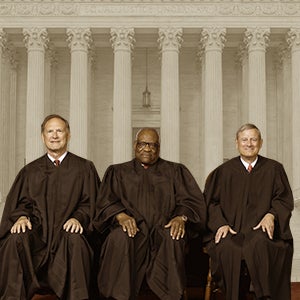
This week, Florida took a big step toward protecting religious liberty. Attorney General James Uthmeier issued an opinion confirming that under federal and state law parents may have their public school children attend religious instruction off campus.
After several school districts in Florida issued blanket denials for the programs, this opinion positively impacts both parents and organizations including our client LifeWise Academy.
“This opinion serves as a model for how states and local school districts should view release time religious instruction,” said First Liberty Senior Counsel Jeremy Dys, “as they work to support and serve parents who entrust part of the education of their children to our public schools.”
Joel Penton, CEO of LifeWise, said, “Across Florida and the country, we’re seeing growing demand from parents who want this option for their children. We appreciate Attorney General Uthmeier’s and Sen. Yarborough’s leadership in affirming that this longstanding educational opportunity remains available to Florida families. With greater clarity around the law, we’re excited to work with even more families who see the positive impact of our program.”
New Jersey Town is Making It HARDER
for Teen Residents to Overcome Addiction
The town of Clinton, New Jersey is threatening to restrict residents’ access to addiction recovery.
Adult and Teen Challenge is a faith-based ministry that helps people fight addiction through a residential program. For seven years, the town raised no concerns regarding the operation of the program or identified any zoning violations.
But when the ministry submitted an application for site improvements on its 88-acre property, the town forced the ministry into a bureaucratic purgatory that has lasted for over two years. During these years of administrative hearings, the town’s officials have subjected the ministry to outlandish lines of questioning and cynical comments regarding its Christian identity and parachurch status. The town also fined them $2,000, with an additional $1,000 per week for continued violations, claiming they had already made changes without approval.
Jeremy Dys, Senior Counsel for First Liberty, said the town’s actions are interfering with Adult and Teen Challenge’s efforts to do what they do best: help broken people.
“Cities should welcome ministries that help vulnerable citizens, not block them with bureaucracy,” he said. “The Clinton Township has reached for the petty tools of government to harass and restrict Adult & Teen Challenge’s ministry.”
First Liberty sent a demand letter explaining that the officials’ actions are unlawful and discriminatory. We’re asking that all permits be issued so the ministry can continue to operate and fulfill its vital mission.
Changing & Saving Lives. That’s The Power of Religious Liberty.
Your support of First Liberty is so powerful it can completely change the trajectory of someone’s life.
That’s the difference you made for Joe in Colorado. He’s one of many people directly impacted by the ministry of First Liberty’s client, The Rock Church.
First Liberty took the church’s case to federal court. The result? A major victory that protects The Rock’s right to continue serving people needing immediate help.
Because of First Liberty supporters like YOU, the church is still offering temporary shelter to people suddenly have no place to go with two RV’s parked on its property.
With the church’s help, the safety of an RV, and the love of a community of Christians, drug addiction no longer lays claim to Joe. He is free! More than that, he’s a productive member of the community, gainfully employed and living in a place of his own.
That’s how your generosity impacts real lives and real people!

But a pastor in the Buckeye State is still fighting for that same freedom: Chris Avell of Dad’s Place Church.
Every day, people in Bryan, Ohio facing are welcome to come through this church’s doors 24 hours a day, 7 days a week. It’s a warm, welcoming, safe place to be.
Instead of applauding the church’s compassion, city officials hit Chris with criminal charges, fines and threats of jail time. They demanded the church stop caring for people in need.
Pastor Chris refused.
Today, First Liberty is fighting for his ministry in court. This case is about far more than one church, though. It’s about whether government officials can selectively punish churches for carrying out the mission God calls them to fulfill.
Right now, you have an opportunity to help keep the church doors open.
P.S. | When you give by June 30, your gift will have a multiplied impact thanks to our Fiscal Year End $250,000 Challenge Grant!
Leading The Conversation | First Liberty in the News
It Must Be June, As Hysterical Leftists Whine They Want to Pack the Supreme Court – President and CEO Kelly Shackelford on Fox News
Video | The Ten Commandments Are a Part of America’s Historical Foundation – President and CEO Kelly Shackelford in Texas Values Report
Opinion | How D-Day Helped Secure Religious Liberty – Executive Director of External Affairs & Senior Counsel Mike Berry in National Review
On D-day, Did FDR Violate the Establishment Clause? – Senior Counsel Jordan Lorence on SCOTUSblog
Mid-Michigan Church Files federal Lawsuit Claiming Township Has Restricted Religious Activities – Senior Counsel Ryan Gardner on WILX News 10
Opinion | Protecting Religion: The Battlefield of the Future – Senior Counsel Christopher Motz on Daily Signal
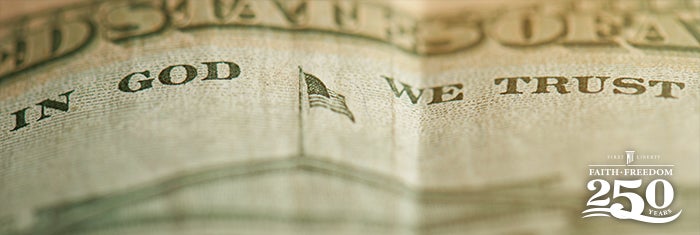
In God We Trust: How Four Words
Became an American Tradition
by Amelia Metz, First Liberty Intern
Have you ever wondered where “In God We Trust” originated?
Was the phrase, word-for-word, coined by the Founding Fathers?
Technically? No. Influenced? Absolutely.
God’s presence is all throughout the founding of America.
In 1776, the Second Continental Congress met at the Pennsylvania State House to pass a resolution declaring May 17 a “Day of Fasting, Prayer, and Humiliation” – a day of national repentance.
The Declaration of Independence was written with God in mind in June of 1776. The second paragraph states:
“We hold these truths to be self-evident, that all men are created equal, that they are endowed by their Creator with certain unalienable Rights, that among these are Life, Liberty and the pursuit of Happiness.”
And the final paragraph:
“We, therefore, the Representatives of the united States of America, in General Congress, Assembled, appealing to the Supreme Judge of the world for the rectitude of our intentions…”
“And for the support of this Declaration, with a firm reliance on the protection of divine Providence, we mutually pledge to each other our Lives, our Fortunes and our sacred Honor.”
In Francis Scott Key’s “The Star-Spangled Banner,” written in 1814, a version of the phrase appeared. The seldom-sung fourth stanza includes the line:
“And this be our motto – ‘In God is our trust.’”
Though the adoption of “In God We Trust” was kickstarted by the founding, defining moments in our history wove faith-driven language into our official vocabulary as Americans sought national unity.
During the Civil War, soldiers and their families turned to faith in response to the fear, uncertainty and suffering of war. In those difficult years, Secretary of the Treasury Salmon P. Chase received many letters encouraging the U.S. to acknowledge God in currency. Many Americans believed recognizing the nation’s trust in God would protect them during the war.
The Rev. Mark R. Watkinson wrote in a letter to Chase in 1861:
“This would relieve us from the ignominy of heathenism. This would place us openly under the Divine protection we have personally claimed. From my hearth I have felt our national shame in disowning God as not the least of our present national disasters.”
One week later, Chase wrote to James Pollock, the Director of the Mint, urging him to take action.
“No nation can be strong except in the strength of God, or safe except in His defense. The trust of our people in God should be declared on our national coins.”
Three years later, Congress passed the Coinage Act of 1864, which introduced the two-cent piece. On that coin, “In God We Trust” was implemented on currency for the first time.
A year later, Congress passed an act allowing the phrase to be on any coin with enough space to fit. By 1938, it was appearing on every coin.
The 84th Congress voted to make it the national motto, and President Dwight D. Eisenhower, signed it into law in 1956. A year later, the U.S. began consistently printing the phrase on paper currency.
Those were the Cold War years, a time when there was a deep sentiment to clearly set the nation apart from the godless Soviet Union.
In spite of America’s founding by people in search of religious freedom, modern critics claim having “In God We Trust” as the national motto goes against the very reason for the founding.
However, the courts have made clear that “In God We Trust” is not a government establishment of religion. The legal doctrine is known as “ceremonial deism.” Similar to the federal government giving employees time off for the Christmas holiday, the term is deeply rooted in history and tradition.
As we approach the nation’s 250th birthday, remembering the origins of our national motto helps us better understand our DNA as Americans. We are a people who have confidently placed our trust in God from the very beginning.
Editors’ Picks | Stories Around the Nation
Opinion | Democrats Are Demonizing the Supreme Court Now to Justify Packing It Later – The Hill
What I Learned About Faith And Fatherhood From Charlie Kirk – The Wall Street Journal
‘It’s Bible Time’: How Religion Became Part of The USMNT’s World Cup Identity – The Guardian
Barna Survey Finds Nearly Half of Practicing Christians Trust AI for Spiritual Growth – Christianity Daily
In 1649, Religious Liberty Was New. A Maryland Law Helped Embed It in America’s Founding. – Christian Science Monitor