by Amelia Metz • 3 minutes
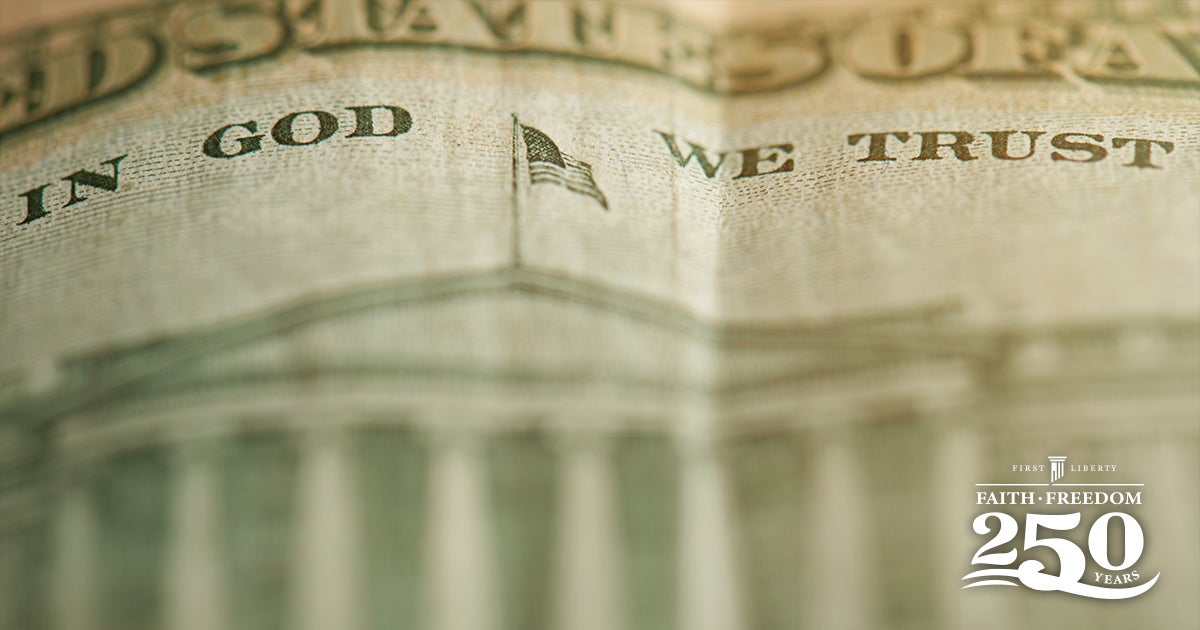
Have you ever wondered where “In God We Trust” originated?
Was the phrase, word-for-word, coined by the Founding Fathers?
Technically? No. Influenced? Absolutely.
God’s presence is all throughout the founding of America.
In 1776, the Second Continental Congress met at the Pennsylvania State House to pass a resolution declaring May 17 a “Day of Fasting, Prayer, and Humiliation” – a day of national repentance.
The Declaration of Independence was written with God in mind in June of 1776. The second paragraph states:
“We hold these truths to be self-evident, that all men are created equal, that they are endowed by their Creator with certain unalienable Rights, that among these are Life, Liberty and the pursuit of Happiness.”
And the final paragraph:
“We, therefore, the Representatives of the united States of America, in General Congress, Assembled, appealing to the Supreme Judge of the world for the rectitude of our intentions…”
“And for the support of this Declaration, with a firm reliance on the protection of divine Providence, we mutually pledge to each other our Lives, our Fortunes and our sacred Honor.”
In Francis Scott Key’s “The Star-Spangled Banner,” written in 1814, a version of the phrase appeared. The seldom-sung fourth stanza includes the line:
“And this be our motto – ‘In God is our trust.’”
Though the adoption of “In God We Trust” was kickstarted by the founding, defining moments in our history wove faith-driven language into our official vocabulary as Americans sought national unity.
During the Civil War, soldiers and their families turned to faith in response to the fear, uncertainty and suffering of war. In those difficult years, Secretary of the Treasury Salmon P. Chase received many letters encouraging the U.S. to acknowledge God in currency. Many Americans believed recognizing the nation’s trust in God would protect them during the war.
The Rev. Mark R. Watkinson wrote in a letter to Chase in 1861:
“This would relieve us from the ignominy of heathenism. This would place us openly under the Divine protection we have personally claimed. From my hearth I have felt our national shame in disowning God as not the least of our present national disasters.”
One week later, Chase wrote to James Pollock, the Director of the Mint, urging him to take action.
“No nation can be strong except in the strength of God, or safe except in His defense. The trust of our people in God should be declared on our national coins.”
Three years later, Congress passed the Coinage Act of 1864, which introduced the two-cent piece. On that coin, “In God We Trust” was implemented on currency for the first time.
A year later, Congress passed an act allowing the phrase to be on any coin with enough space to fit. By 1938, it was appearing on every coin.
The 84th Congress voted to make it the national motto, then President Dwight D. Eisenhower signed it into law in 1956. A year later, the U.S. began consistently printing the phrase on paper currency.
Those were the Cold War years, a time when there was a deep sentiment to clearly set the nation apart from the godless Soviet Union.
In spite of America’s founding by people in search of religious freedom, modern critics claim having “In God We Trust” as the national motto goes against the very reason for the founding.
However, the courts have made clear that “In God We Trust” is not a government establishment of religion. The legal doctrine is known as “ceremonial deism.” Similar to the federal government giving employees time off for the Christmas holiday, the term is deeply rooted in history and tradition.
As we approach the nation’s 250th birthday, remembering the origins of our national motto helps us better understand our DNA as Americans. We are a people who have confidently placed our trust in God from the very beginning.