Discrimination Doesn’t Fly:
Major Victory for Flight Attendants
Great news! We just had a major victory in our Alaska Airlines case involving Lacey Smith and Marli Brown, flight attendants who were fired for their faith.
The 9th U.S. Circuit Court of Appeals ruled in favor of our clients. The court held that there is enough evidence for a jury to find that our clients were discriminated against because of their religious beliefs. The case now goes back down to the district court for trial.
Today’s decision is significant, but this legal battle is far from over.
There’s a long stretch of litigation still ahead. Next, we’ll prepare to argue the case at trial and prove before a jury that Alaska Airlines violated the law by firing our clients. And that their union, and the Association of Flight Attendants, also discriminated against them.
Thank you for supporting Lacey, Marli and First Liberty. This victory would not have been possible without your faithful support. We still have work to do, but we are getting closer to that final victory that will restore our client’s rights and the religious freedom of millions of Americans.
‘Yes’ to Poker Nights, But ‘No’ to Prayer Gatherings
Be careful if you live in Irvine, California. The city will fine you if you host people to pray in your home.
Our client, Rabbi Rafi Dadon, holds Jewish prayer meetings and weekly Shabbat meals at his house. But last year, the city began fining Rabbi Dadon for each gathering, claiming he was using his home as a synagogue.
Any day of the week across the country, Americans of all faiths meet in homes for prayer meetings, Bible studies and other gatherings. But city officials in Irvine have singled out this Jewish rabbi for hosting small, invitation-only religious gatherings. Meanwhile, it’s perfectly okay for neighbors to host poker nights, wine tastings or music jam sessions.
No one should be punished for their prayers, especially not at home—one of the most sacred and protected spaces for the free exercise of religion.
First Liberty sent a demand letter notifying officials that they’re violating federal law and the Constitution. They need to follow the law, do what’s right and allow Rabbi Dadon to host prayer gatherings at home without any restrictions.
Thank You for Committing to Defend Religious Liberty
Thank you for celebrating with us during First Freedom Day. If you joined the Wall of Champions, a special thank you.
Your gift to First Liberty helps our clients get back to living out their divinely inspired calling.
Because of supporters like you, First Liberty has won five landmark victories at the U.S. Supreme Court. These precedent-setting cases are restoring religious freedom across America.
This year we reached our $20,000 Matching Grant and exceeded our $30,000 goal. Watch the video below to see your name on the First Liberty Wall of Champions, a tribute to those helping preserve religious liberty for generations to come.
Securing religious freedom today, tomorrow and for the next 250 years. That’s the power of your gift to First Liberty.
If you missed the chance to give during First Freedom Day, it’s not too late. When you give by June 30, your gift will have a multiplied impact thanks to our Fiscal Year End $250,000 Challenge Grant!
 Tearing Down the Wall:
The True Meaning of Jefferson’s Separation of Church and State
by Erin Reynolds, First Liberty Intern
Leading up to the Fourth of July, the White House hosted “Rededicate 250: A National Jubilee of Prayer, Praise & Thanksgiving.” Since that May event, some Americans have been complaining that it was a violation of the so-called “separation between Church and State.”
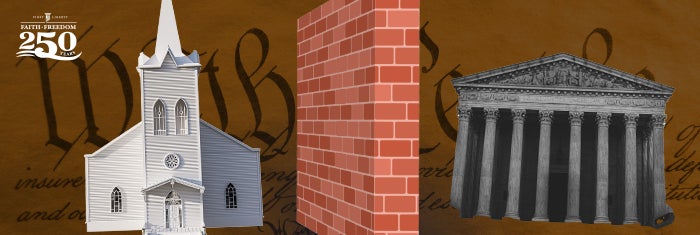
Much of their argument revolves around the claim that the phrase appears in the U.S. Constitution. But it doesn’t. The first mention of a “wall of separation” is in a letter Thomas Jefferson wrote in reply to the Danbury Baptist Association in Connecticut.
While the Danbury Baptists had freedom of religion, they were discriminated against by the state for not being a part of the Congregationalist Church. This was the established church of Connecticut, funded by taxpayer money.
They wrote to Jefferson, thanking him for his stand on religious liberty and bringing to his attention the lack of freedom they were experiencing. What religious privileges we enjoy (as a minor part of the State) we enjoy as favors granted, not as inalienable rights: and these favors we receive at the expense of such degrading acknowledgments, are inconsistent with the rights of freemen.
They were concerned the federal government might establish a national church or whether they would have true freedom of religion. Jefferson wrote back his famous reply.
I contemplate with sovereign reverence that act of the whole American people which declared that their legislature should ‘make no law respecting an establishment of religion, or prohibiting the free exercise thereof,’ thus building a wall of separation between Church & State.
In context, it’s clear this wall of separation was not created to keep the religion out of the State. It was simply intended to protect religious freedom and to place boundaries on the State’s control over the Church.
Garth Kant, in his article “God and Government,” summed this up well: “Jefferson opposed a ‘national’ religion. He did not oppose a religious nation. Or a religious government. He opposed a government religion. The difference is critical.”
In fact, the United States Capitol served as a church building for seven decades and Jefferson himself was a regular attendee. He attended so faithfully that he earned a reserved seat. On the Sunday after he wrote the letter to the Danbury Baptists, he attended church services at the still-under-construction Capitol.
This is a perfect example of how Jefferson’s “wall of separation” was never meant to keep religion completely out of government. Instead, faith has a home in America – even in the Capitol.
Another example would be the Constitutional Convention, the gathering to lay a more solid foundation for the new government. After several weeks of tension and fierce debate, Benjamin Franklin suggested they pray.
All of us who were engaged in the struggle must have observed frequent instances of a Superintending providence in our favor… do we imagine that we no longer need His assistance… I therefore beg leave to move — that henceforth prayers imploring the assistance of Heaven, and its blessings on our deliberations, be held…
During this brief recess for religious gatherings, Rev. William Rogers led a prayer for the Convention, asking the Lord for wisdom and unity. Edmund Randolph of Virginia also suggested that a public sermon be delivered to the delegates. After, it was evident there was a tangible shift in the room. Disagreements were resolved, and the Constitution was finalized.
Jefferson never meant to wall off the Church from public life. Instead, faith is an important part of American history and tradition. Calling for Americans to cry out to a Higher Power aligns with the thoughts and actions of the Founding Fathers. Their actions were shaped by their faith, and 250 years of history stand as a testament to it.
Leading The Conversation | First Liberty in the News
Trump 2.0 Puts Religious Liberty Back on Offense – Senior Counsel Jeremy Dys on The Blaze
Podcast | Religious Liberty Back on the Offense – Senior Counsel Jeremy Dys on The Steve Gruber Show
Principled Jurists are Needed in the Federal Judiciary – Senior Counsel Jordan Lorence on Townhall
Essay | Jefferson and Wheatley: Fact, Myth, and the Great Tradition – Center for Religion, Culture & Democracy Research Fellow Kirstin Anderson Birkhaug on Reading Wheel Review
Essay | Phillis Wheatley: Poet and Public Intellectual – Center for Religion, Culture & Democracy Senior Fellow John A Nunes on Reading Wheel Review
 How Religion Precedents Die Before They Are Overruled
by Adam Feldman, J.D., Ph. D.
By the time the Supreme Court says a precedent has been “abandoned,” much of the decisive work has often already occurred. That was the story of Lemon v. Kurtzman. For decades, the Court invoked, revised, sidestepped, and criticized Lemon’s Establishment Clause test. It remained in the U.S. Reports, and lower courts still had to account for it. But after Kennedy v. Bremerton School District, Lemon was effectively gone.
A similar, though unfinished, story is unfolding around Employment Division v. Smith. Smith remains the formal rule for many Free Exercise claims: neutral and generally applicable laws ordinarily do not violate the Free Exercise Clause merely because they burden religion. But the Court’s modern cases have narrowed the set of laws that receive that deferential treatment. The question is not only whether Smith has been overruled, but whether it still organizes the doctrine.
Citation data cannot prove whether a precedent remains healthy, but they can show where stress is accumulating: how often a case is cited, how often courts treat it negatively, whether the Supreme Court joins that treatment, and whether recent citations are rising or falling.
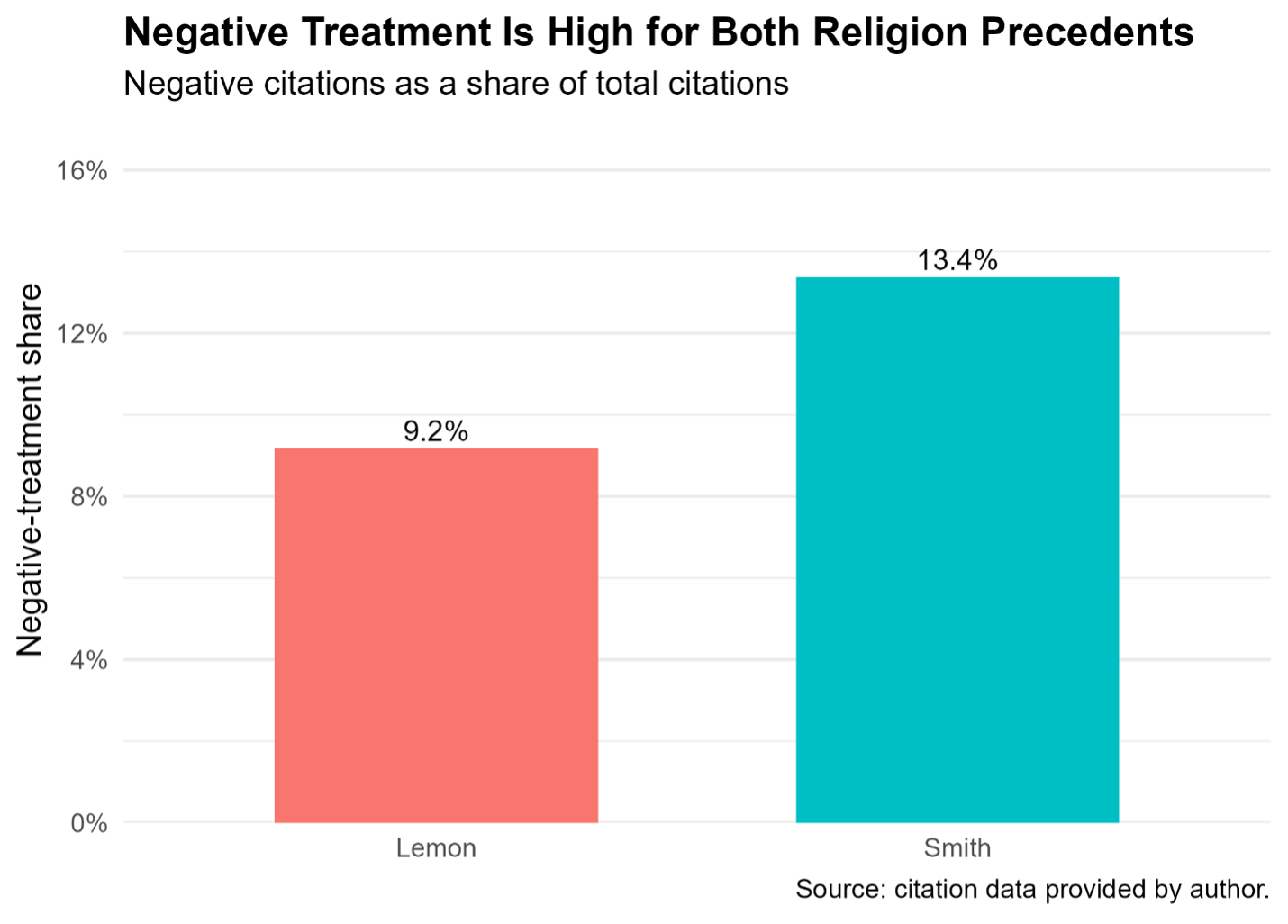
In the data, Smith has 2,901 total citations and 388 negative citations, producing a negative-treatment share of 13.4 percent. Lemon has 2,255 total citations and 207 negative citations, for a negative-treatment share of 9.2 percent. Both cases therefore show substantial doctrinal strain, though they have followed different paths.
Lemon is the clearer example of functional abandonment. The Court did not overrule it cleanly until Kennedy. Instead, it gradually displaced the test. Lemon once supplied the familiar three-part Establishment Clause inquiry: secular purpose, primary effect, and excessive entanglement.
For years, that framework structured Establishment Clause litigation, especially in lower courts.
But the Court repeatedly declined to treat Lemon as controlling. In cases involving religious symbols, legislative prayer, monuments, and longstanding public practices, the Court increasingly turned to history, tradition, and context. Lemon became less a command than a reference point. Eventually, in Kennedy , the Court said it had “long ago abandoned” Lemon and the endorsement-test offshoot.
That sequence makes a difference. Lemon did not lose authority because courts stopped citing it. It lost authority because the Supreme Court stopped using it to decide cases. The formal citation remained, but the operative method changed. By the time the Court announced abandonment, it was already visible across the doctrine.
Smith is different because it remains formally alive. The Court has not replaced it with a general strict-scrutiny rule for all burdens on religious exercise. But it has made the threshold inquiry—whether a law is truly neutral and generally applicable—more consequential.
Under Smith, a neutral and generally applicable law usually receives deferential review even when it burdens religion. Modern pressure comes from the exceptions. A law may fall outside Smith’s safe harbor if it contains individualized exemptions, targets religion, favors comparable secular conduct, or is underinclusive in a way that suggests discrimination.
That is how Smith can weaken while remaining formally controlling. The Court need not reject the rule if it repeatedly narrows the category of laws that benefit from it. Each decision finding non-neutrality, lack of general applicability, or discriminatory under inclusion reduces Smith’s practical reach.
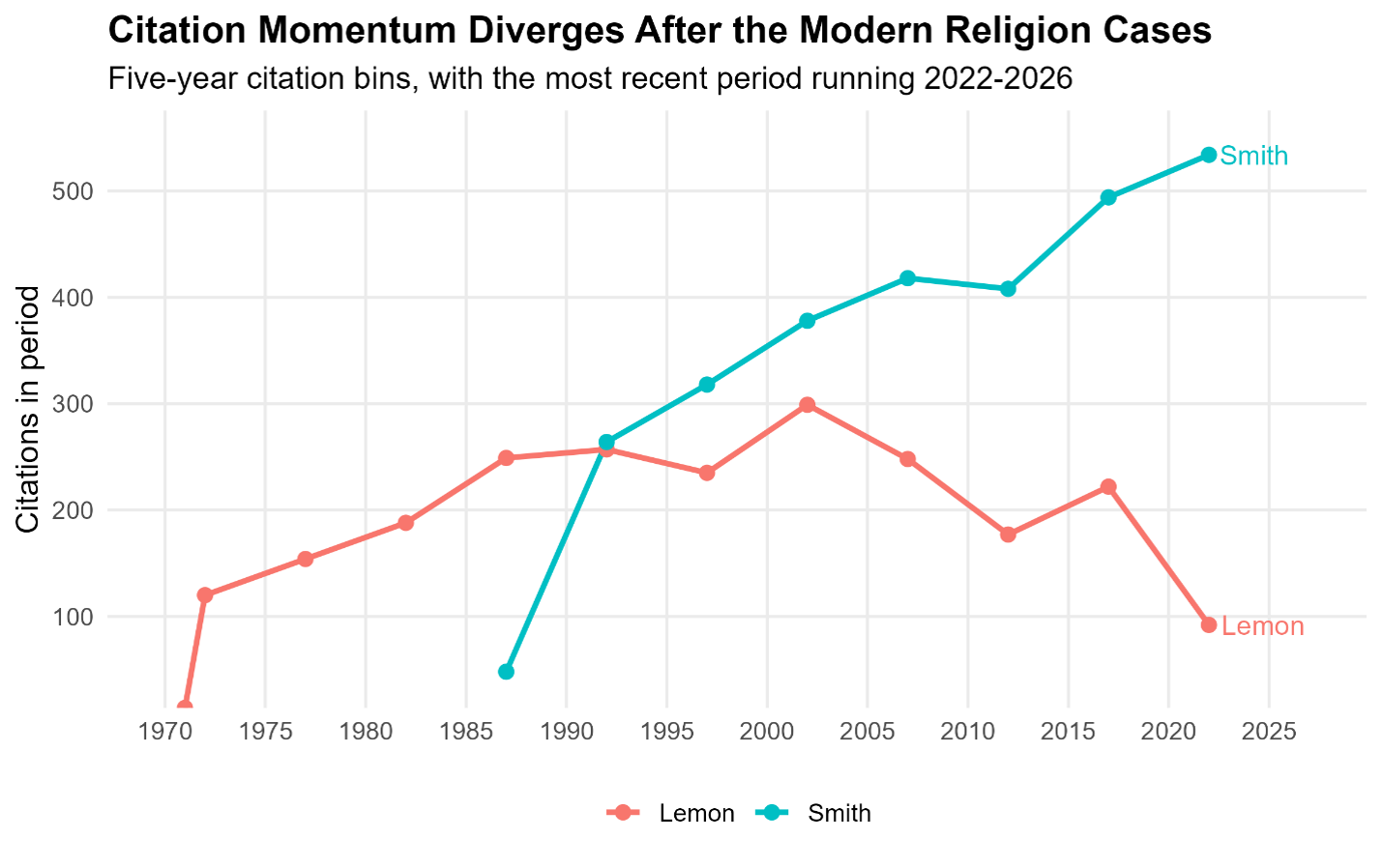
The citation trend reinforces the doctrinal distinction. Lemon’s recent citation volume has fallen after the Court’s move toward history and tradition. Smith, by contrast, remains active. Its recent citation volume reflects continuing litigation over neutrality, general applicability, religious exemptions, and the boundary between ordinary regulation and religious targeting.
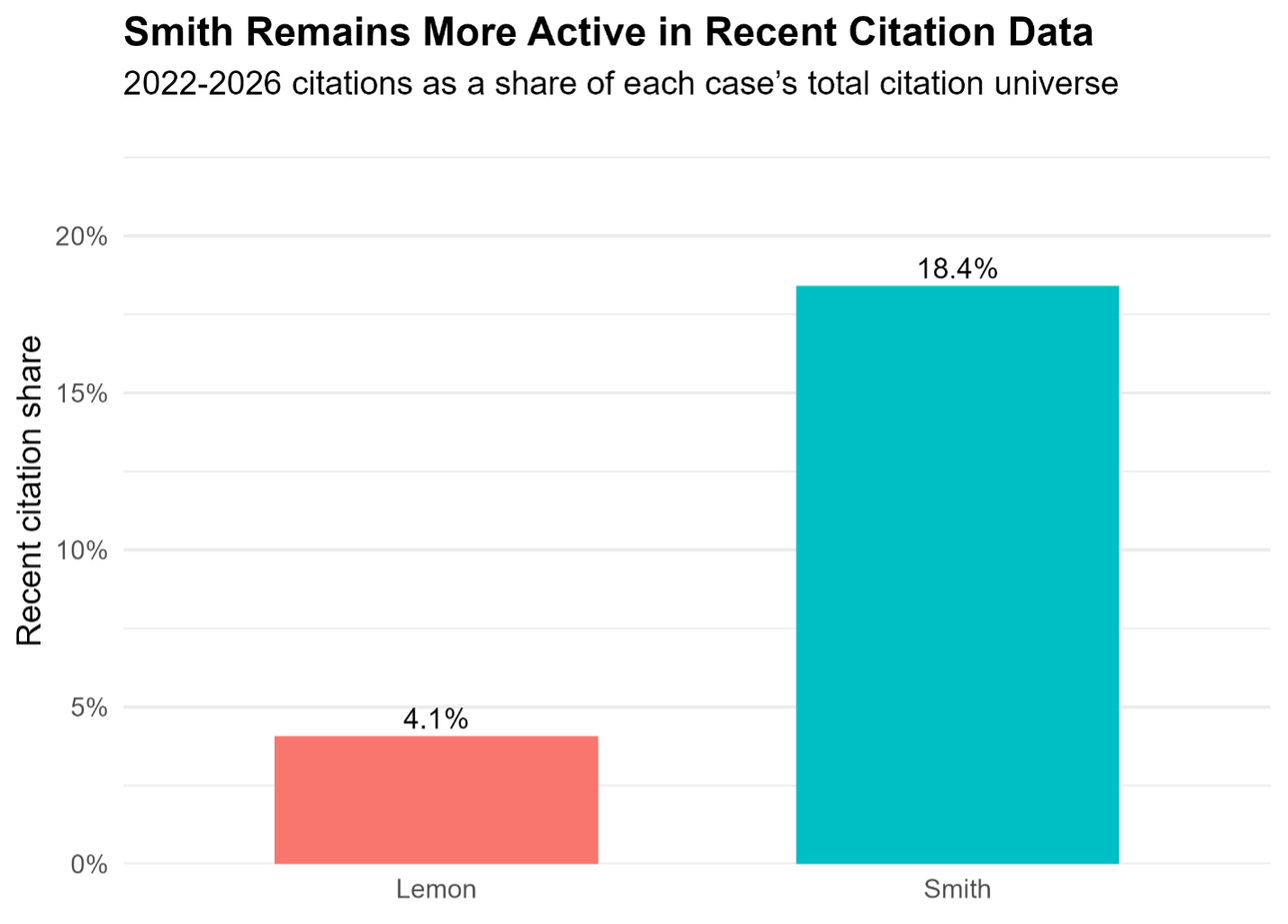
The contrast is useful. Lemon eroded through replacement: the Court moved from a three-part Establishment Clause test to history and tradition. Smith is eroding, if at all, through filtration: the Court keeps the rule but tightens the gateway into it. In Establishment Clause cases, the test changed. In Free Exercise cases, preliminary classification became decisive.
These precedents show how doctrine can change before the Court uses the word “overruled.” A case may remain formally cited while losing its practical role. It may be narrowed, translated, bypassed, or surrounded by exceptions.
That is the deeper lesson of Lemon and Smith. Formal overruling is only one way a precedent dies. Sometimes a precedent is declared abandoned after years of displacement. Sometimes it survives after the Court has reduced the territory it governs. The question is whether the precedent still does real doctrinal work.
The staying power of Smith will be further tested in the upcoming Supreme Court Term, when the justices hear St. Mary Catholic Parish v. Roy. The case asks whether lack of general applicability under Smith requires unfettered discretion or categorical exemptions for identical secular conduct, and whether Carson v. Makin displaces Smith only when the government explicitly excludes religious people or institutions.
— — —
Note: This is an edited version of Dr. Feldman’s article that originally appeared on his Substack: Legalytics. It was produced with Dr. Feldman’s consent.
Editors’ Picks | Stories Around the Nation
Religious, Civic Leaders Join Pope Leo for Liberty Medal Award Ceremony – OSV News
Opinion | Liberty or Force? John Quincy Adams on American Foreign Policy – Daily Signal
Giants Pitchers Take Bold Faith Stand on Pride Night, Writing Bible Verses on Caps – The Lion
5 Powerful Moments of Faith at the 2026 FIFA World Cup – The Inquirer