by Amelia Metz, First Liberty Intern • 3 minutes
Whenever you’ve attended a sporting event or holiday celebration, you’ve probably sung “The Star-Spangled Banner.” It’s a song most Americans know by heart. You may not even remember being taught the lyrics — you just knew it.
But one part you may not know is that the version of the song we sing at events is only the first stanza. Francis Scott Key wrote three more.
The lesser-known fourth stanza reads like a prayer.
O thus be it ever when freemen shall stand
Between their lov’d home and the war’s desolation!
Blest with vict’ry and peace may the heav’n rescued land
Praise the power that hath made and preserv’d us a nation!
Then conquer we must, when our cause it is just,
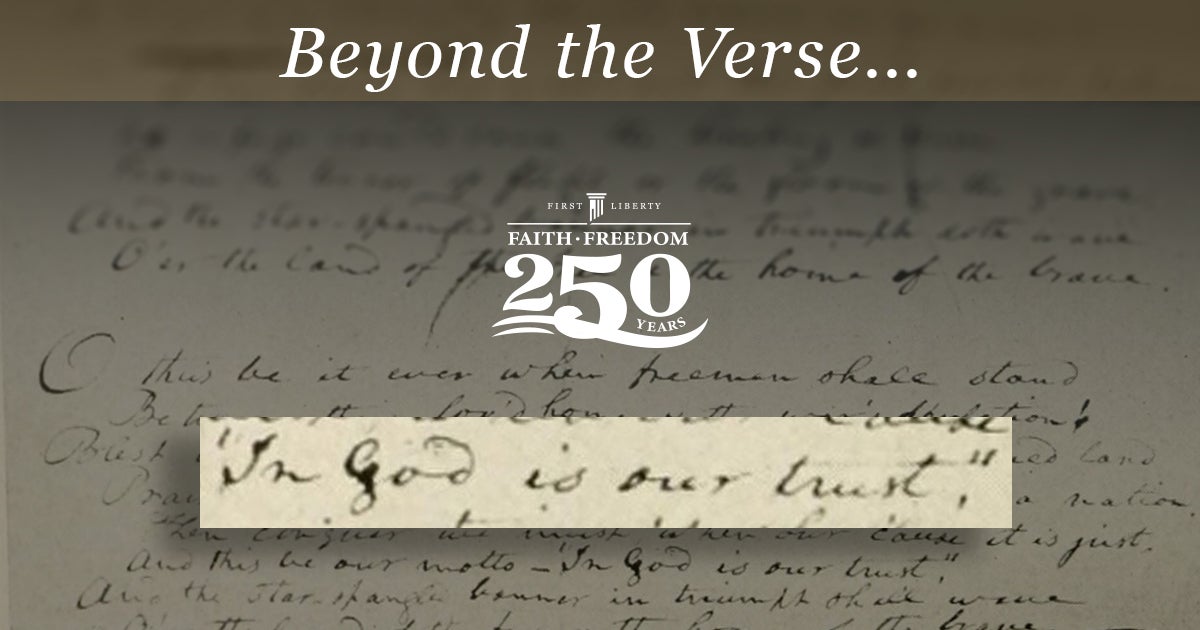
And this be our motto – “In God is our trust,”
And the star-spangled banner in triumph shall wave
O’er the land of the free and the home of the brave.
The often-hidden stanza reveals how religious language influenced our nation’s identity from the beginning.
But this faith-driven style of communication did not remain confined to Key’s quill and paper. Over time, it became embedded into the broader civic identity of the United States.
“The Star-Spangled Banner” was written in 1814 but did not become the official national anthem until President Herbert Hoover signed it into law in 1931, over a century later.
What Key may not have expected is that a particular phrase in his song would later find itself a permanent home in American lingo.
The line “And this be our motto – ‘In God is our trust’” foreshadows the establishment of the American motto — “In God We Trust.” President Dwight D. Eisenhower made it the national motto in 1956.
This is about more than just forgotten lyrics. It offers a window into the values that shaped American identity — individualism, equality, opportunity, freedom and, as Key suggests, faith.
He expresses that the victory of the American Revolution came from God rescuing the American people: “Blest with vict’ry and peace may the heav’n rescued land…”
In the line “Praise the power that hath made and preserv’d us a nation,” Key articulates that there was a Higher Power guiding us to and through the establishment of the United States. Man alone did not create this nation — God did.
This shows that faith wasn’t just a label used lightly. It expressed the Divine Providence of God throughout the development of the nation.
The tree of American culture is rooted in faith and patriotism. This root — the love of God and of country — is what allows all other values to grow. By infusing these two core values into our nation’s identity, the founding patriots successfully found the characteristics they had searched for in a free country. Rights come from God, not from men. By being gifted with the rights of individualism and equality, we have found freedom in opportunity.
From the “Declaration of Independence” to “The Star-Spangled Banner,” faith has appeared in patriotic texts and events, highlighting the importance of the Free Exercise Clause in our daily lives.
The fact that the fourth stanza of the anthem is one that is lesser-known reveals an unfortunate truth about our country’s memory:
Public memory has favored convenience. By forgetting the final stanza, we have removed the conviction, ignored the duty, and forgotten the virtue our nation has been called to.
So, as we approach the 250th anniversary celebration of our nation, it’s important to remind ourselves of our history and the reason for our founding.
Since the beginning, faith-based patriotic traditions have helped Americans find unity in shared purpose, meaning and language.
“The Star-Spangled Banner” shows how centuries-old text can endure the changes of time and be formalized far beyond the creator’s lifetime. Remembering these forgotten words can help Americans better understand who we are as a nation.