by Amelia Metz • 3 minutes
On January 20, 2017, my seventh-grade classmates and I sat in old red theater seats in the school’s auditorium. It was a Friday, and we were excited to be out of the classroom. Any event — even one as boring as watching a presidential inauguration — was better than doing Punnett squares.
But we didn’t realize then how much watching President Donald Trump take the oath of office would shape our educational experience.
Like many students across America, we first encountered the presidential inauguration in the classroom. It taught us about the peaceful transfer of power and the role religious traditions play in inaugural ceremonies.
If you look closely, you’ll most likely see the president’s hand on a Bible. At President Trump’s inauguration in 2017 (and in 2025), he placed his hand on his childhood Bible and the Bible that Abraham Lincoln used at his ceremony. You also may hear them add the words “So help me, God” to the end of their oath.
But neither of these traditions — swearing on the Bible or “So help me God” — are required by the Constitution. It is a tradition started by George Washington and followed by the majority of his successors.
The tradition actually has quite humble beginnings, sparked by a small last-minute detail at the first presidential inauguration.
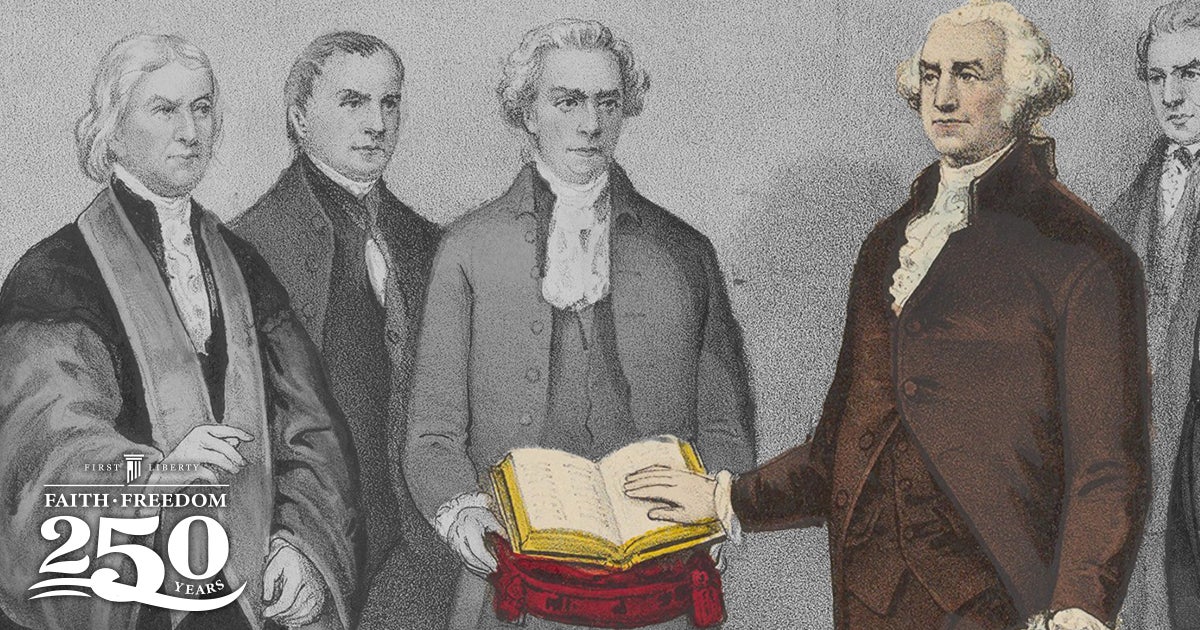
George Washington’s 1789 inauguration had been carefully planned with one important detail missing: a Bible for him to place his hand on while taking the oath.
Jacob Morton, the parade marshal and master of the nearby Masonic Lodge, ran back and borrowed its Bible — a 1767 King James Version printed in London — for the ceremony.
After taking the oath of office, Washington kissed the Bible, which was turned to Genesis 49.
He set the precedent of fearlessly including faith in the ceremony — a precedent that would leave a lasting impression. Four presidents after him decided to place their hand on the same Bible: Warren Harding, Dwight Eisenhower, Jimmy Carter, and George H.W. Bush.
In 1921, Warren Harding was the first president to use the Washington Bible. After 132 years, what happened? Why did it take so long for another president to use that Bible?
The borrowed Bible never made its way into the hands of the government. After the ceremony, it was returned to the lodge. To this day, the lodge still owns the original Bible.
In the meantime, many other presidents have used a family Bible.
There have only been a handful of presidents who opted out of using a Bible. John Quincy Adams swore on a constitutional law book. Theodore Roosevelt didn’t use a book at all because he was quickly sworn in at his home after President William McKinley was assassinated. Lyndon B. Johnson used a Catholic missal, thinking he was using a Bible.
But there has yet to be a president who has sworn on a non-Christian religious text. That detail speaks to the original presence — and long-lasting tradition — of the Judeo-Christian values in American politics and government. Presidents aren’t expected to leave their faith at the door — it’s something that’s right there with them from the very first moment of their presidency.
There is a difference between government speech and a government official who is speaking. The Free Exercise Clause in the First Amendment protects your right to practice any or no religion at all. It does not, however, extend to protecting anyone from simply hearing another person’s faith being expressed.
Swearing on something greater than yourself creates a form of accountability that goes beyond what any person or institution alone can provide. It’s the same concept we see in the courtroom. For centuries, placing your hand on a Bible has been a way of acknowledging that you answer to a power higher than human authority.
For the president, that weight is no different. Not only are they held accountable by the American people — they’re held accountable by God.
As we celebrate America’s 250th birthday, it’s worth recognizing that this tradition stretches far beyond 250 years. Faith has been woven into the fabric of who we are as a nation since our founding — and, in many ways, since the beginning of time itself.