Will Connecticut Allow Religious Displays at the State Capitol?
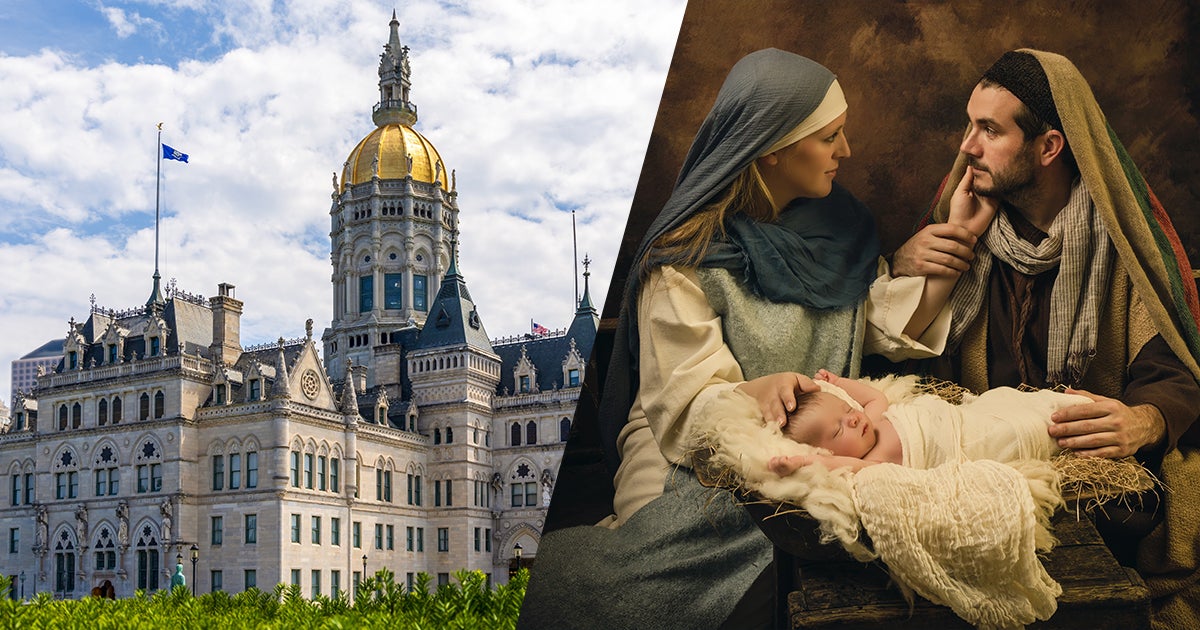
In Connecticut, private religious displays are banned from the state Capitol.
Last December, Family Institute of Connecticut requested to display a small Nativity scene on a table inside the Capitol building. State officials rejected that application, citing a policy that allows private displays in the Capitol unless they are “religious in nature.”
“The ‘no religious display’ policy is such a blatant violation of the First Amendment that it must have been an oversight,” said First Liberty attorney Roger Byron.
First Liberty and the international law firm Jones Day sent a letter asking Connecticut’s Joint Committee on Legislative Management to remove the discriminatory provision from its policy and allow the private Nativity display this Christmas season.
The Committee has until July 27 to respond.
“The law is clear that barring a religious viewpoint from a public forum like this violates the Free Speech Clause,” Byron added. “Hopefully the Committee changes its policy and makes further legal action unnecessary.”
Part 2: Kelly Shackelford Talks ‘Separation of Church & State’
with Texas Lt. Gov. Dan Patrick
Can a public school stop a student from praying? Can a coach pray after a football game? Can your employer tell you to hide your faith? And is “separation of Church and State” really part of the U.S. Constitution?
First Liberty President & CEO Kelly Shackelford continues the conversation with Texas Lt. Gov. Dan Patrick, as they examine some of the most important religious liberty issues facing America today.
In this episode, they discuss the truth about “separation of Church and State,” parents’ and students’ First Amendment rights, the work and recommendations of the President’s Religious Liberty Commission, and why many people—including government officials—so often misunderstand the Constitution.
Whether you’re interested in the U.S. Supreme Court, religious liberty, or the future of the First Amendment, this conversation offers an inside look at one of the defining constitutional debates of our time.
Watch below:

Faith in Schools? America Says It’s Ready for It!
by Amelia Metz, First Liberty Intern
As states move to restore voluntary prayer, religious expression and the Ten Commandments in public schools, a new Pew Research Center survey suggests these efforts have broad public support.
The survey of nearly 3,600 U.S. adults found broad support for religious expression in schools. 78% of adults favor allowing students to voluntarily pray in student-led groups. 57% favor allowing coaches to lead their teams in prayer. 50% favor displaying the Ten Commandments in classrooms.
The message behind these numbers is clear: most Americans want students, coaches, and teachers to have the freedom to express their faith openly, without fear of censorship.
That is exactly the freedom that the First Amendment was written to protect. The Free Exercise Clause guarantees Americans the right to practice religion in every part of life—not just at home, and not just on Sundays.
It’s important to note that public opinion doesn’t settle constitutional questions. But public support can help bust the myth that people don’t want religion active in public life.
The Pew study revealed that the majority of Americans actually do want that freedom to express their closely held values and convictions—and they want others to have that freedom too.
And that support holds up across all generations. While adults 50-and-older are more likely to favor displaying the Ten Commandments in classrooms, a strong percentage of younger Americans back it, too. This position isn’t confined to one age group. Americans see room for faith in public education, and they want it protected.
The takeaway? This shift in cultural attitude and public opinion is no coincidence. It has a lot to do with a seismic shift in religious freedom law over the past decade. And as the laws and precedents have become more favorable for religious freedom, it’s also being reflected in positive public sentiment for religious expression.
That change in the legal landscape is being driven by First Liberty’s major Supreme Court victories, including our Coach Kennedy and Bladensburg Peace Cross cases, which affirmed that government cannot eliminate religion from public life.
In our Coach Kennedy case, the Supreme Court held that a public high school football coach could not be disciplined for offering a prayer on the field after games. The Court rejected the idea that government neutrality requires the elimination of religious expression from public life.
This is exactly the principle that First Liberty has defended: the right of students to pray, the right of coaches to express their own faith without fear of punishment, the right of communities to publicly acknowledge the history and tradition of religion in American life.
As more states, counties, cities and local governments consider bringing prayer, religious expression, and the Ten Commandments back to schools and the public square more broadly, these findings send a clear message: Americans are ready for it.
Wait, Pastor Chris Avell Could Still End Up in Jail?
For Pastor Chris Avell and Dad’s Place, the work of his ministry has received a little breathing room. After being harassed for almost two years, a state court issued a final order in April dismissing the City of Bryan’s civil lawsuit against the church and its 24/7 ministry.
But the legal battle isn’t over. If you recall, the city filed more than 18 criminal charges against Pastor Chris. First Liberty was able to get those dismissed, but the City would not give up. They filed more charges, tried him, and a court convicted him, sentencing him to a $200 fine and a possible 60-days in jail.
We were able to get a court order that put a hold on the criminal sentence, keeping Pastor Chris out of jail for the time being. But there’s an appeal still pending in the state appellate court regarding those criminal charges.
We’re going to fight this case until Pastor Chris is fully free to serve his community—without the threat of being thrown in jail.
Pastor Chris still needs your support. Can he count on you? Please give to First Liberty today.
Leading The Conversation | First Liberty in the News
GOP Lawmakers Urge Supreme Court to Strengthen First Amendment Protections for Street Preachers – Executive General Counsel Hiram Sasser on Fox News
Connecticut Bars Nativity Display in State Capitol Because It’s ‘Religious,’ Lawsuit Threat Says – Senior Counsel Roger Byron on Fox News
Was the War of Independence a Just War – Center for Religion, Culture & Democracy Senior Fellow J. Daryl Charles on Providence
What Is Old is the New World Order Again – Center for Religion, Culture & Democracy Fellow James M. Patterson on Mere Orthodoxy
Religious Freedom’s Economic Benefits – Center for Religion, Culture & Democracy Research Associate Logan Tantibanchachai on Religion & Liberty Online
Coming Full Circle: From First Liberty Intern to U.S. Representative
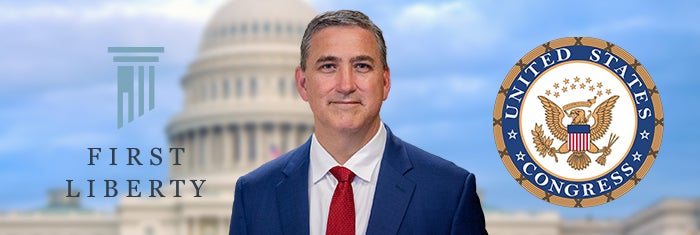
by Mike Berry, Executive Director of External Affairs & Senior Counsel
There is something deeply satisfying when a story comes full circle.
More than two decades ago, a young law student intern, Nathaniel Moran, walked through our doors eager to learn, contribute and make a difference. Like many interns, he expected to spend his days researching, writing and assisting with legal cases and projects. But nobody could have predicted all those years ago that one of his assignments would come full circle.
That summer, Nathaniel was tasked with researching a legal issue that was raised in one of our cases, Barrow v. Greenville Independent School District. He immersed himself in the facts, examined the legal arguments, and helped support our efforts to defend a principle we believed was essential to the preservation of religious liberty. It was the kind of assignment that interns often receive—important work, certainly, but not necessarily work that seems destined for the Supreme Court or that will make national headlines.
As the years passed, Nathaniel moved on. He graduated from law school and built a successful legal career. But from a young age, Nathaniel was taught the importance of public service. He served as a city council member and on the boards of numerous civic and non-profit organizations. Unsurprisingly, Nathaniel eventually followed the call to run for a seat in the U.S. Congress, which he won. Yet the issue he once researched so long ago never disappeared. The legal questions remained. The principles at stake endured. And the work continued.
In a remarkable turn of events, that former intern was the lead member of Congress who filed a friend-of-the-court brief supporting our case in Hershey v. City of Bossier City. And whether by coincidence or by divine Providence, the Hershey case deals with the very same issue he studied all those year ago as a young intern in our office.
Moments like this remind us that life is often less a straight line than a circle. Experiences that seem small in the moment can prove formative. Seeds planted early can bear fruit decades later. A research project can become a lifelong conviction. An internship assignment can become a defining public responsibility.
For those of us who have watched this journey unfold, the moment is especially meaningful because it illustrates the power of investing in the next generation. We often think of internships as temporary experiences. But they are also opportunities to shape future leaders, expose them to important ideas, and encourage them to engage with causes larger than themselves.
In this case, the connection between past and present could hardly be more evident. The same issue that once occupied a young intern’s summer is now the subject of a brief he will submit to the U.S. Supreme Court. His audience has changed. His responsibilities have grown. But Nathaniel’s commitment to religious liberty remains.
There is a lesson in that continuity. Important causes are rarely won in a single moment. They require persistence across years, and often across generations. The people involved may change, but the principles endure. Each generation receives a baton from those who came before and carries it forward in new ways.
The work we do today may shape opportunities that emerge years from now in ways we cannot predict.
For one former intern, what began as a research assignment has become an opportunity to speak at the highest level. And for everyone who believes in the long-term power of ideas and investment in young leaders, it is a powerful reminder that the most meaningful stories often come full circle.
Editors’ Picks | Stories Around the Nation
Democrats Push Supreme Court Term Limits – SCOTUSblog
Barrett and Kagan’s Safety Plea Exposes the Left’s War on the Supreme Court – American Enterprise Institute
Opinion | Democrats Dismiss Our Constitutional Traditions as ‘Nostalgia’ – The Hill
JD Vance Rejects Arguments Against Texas’ Ten Commandments Law: ‘Cultural Element Of Western Civilization’ – Christian Post
Is Court Packing Inevitable If Democrats Retake Congress and the White House? – Reason
A New Docket Takes Shape: Three More Issues the Supreme Court Will Decide in Its Next Term – National Review