by Jayla Ward • 3 minutes
During the Revolutionary War, many African-American patriots fought for the Continental Army. Men including Wentworth Cheswell, James Armistead Lafeyette, Peter Salem and Oliver Cromwell fought in pivotal battles that determined America’s future.
Wentworth Cheswell, similar to Paul Revere, warned colonists of the British arrival. Prince Whipple and Oliver Cromwell fought alongside Gen. George Washington and are depicted in the famous painting, “Washington Crossing the Delaware.”
James Armistead was born a slave in 1760, living most of his life on a plantation in Virginia. After receiving permission from his master, he joined the allied forces under Marquis De Lafayette. He ended up becoming a spy for the French unit, posing as a runaway slave and eventually gaining access to General Cornwallis’ command center.
Thanks to his intel, Lafayette and Washington thwarted many British advances. The most critical being the Battle of Yorktown. Armistead learned of Cornwallis’ plan to bring in reinforcements that would overwhelm the American forces. Thanks to this information, the Americans were able to build a blockade. This victory was one of the final wins that led to the end of the Revolutionary War.
However, many former slaves including Armistead were forced to return to slavery after the war, instead of earning their freedom, which warrants the question, “Why?” Why fight? Why would a slave fight for a nation that had enslaved him?
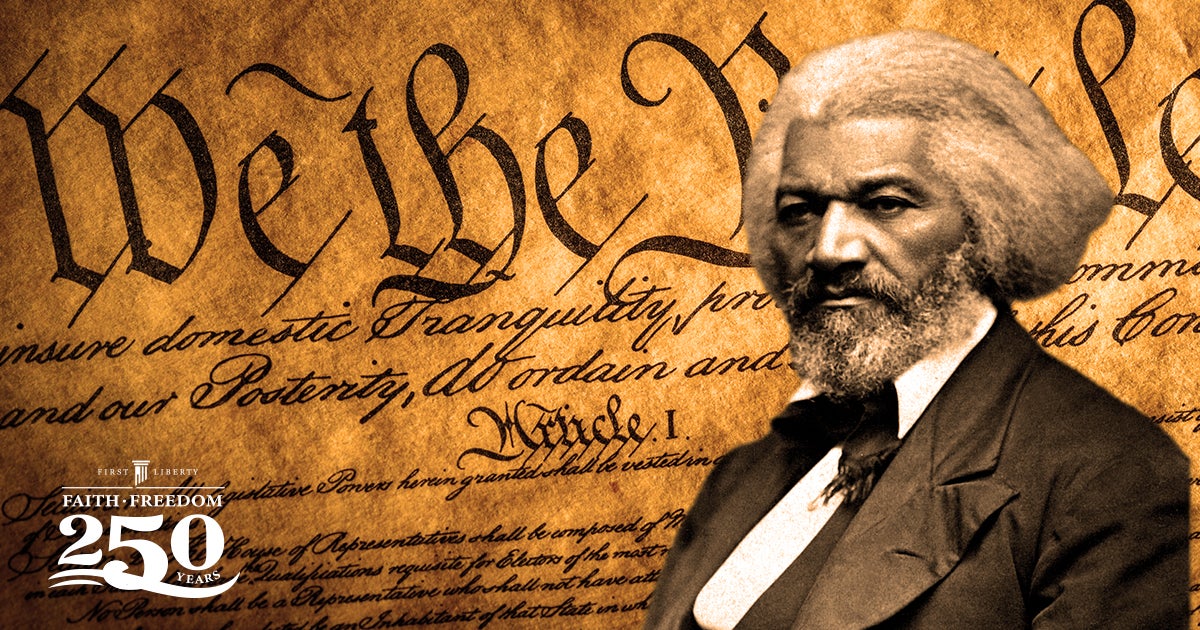
Frederick Douglass offers some insight. Like Armistead, Douglass grew up in slavery until he escaped to New York in 1883. After being free for only three years, Douglass became a renowned advocate for the abolition of slavery. During and after the Civil War he was appointed to prominent positions by Presidents Abraham Lincoln and Ulysses S. Grant.
In his writings, he notes how he struggled with the Founding Fathers’ seemingly contradictory character. Though they advocated for freedom, slavery was robust throughout the colonies. Yet after conducting his own research on the Constitution, Declaration of Independence, and other writings, he concluded that the Framers’ intent was not malicious but instead visionary.
Douglass argues in his Independence Day address that if it were to be a pro-slavery document, why can “not one word can be found in the Constitution to authorize such a belief.” It diametrically opposes it.
The Constitution is a glorious liberty document. Read its preamble; consider its purposes. Is slavery among them? Is it at the gateway? Or is it in the temple? It is neither… On the other hand, it will be found to contain principles and purposes entirely hostile to the existence of slavery.
While the Framers were not perfect, they understood that freedom should be extended to every MAN. Though they knew they may never see it in their lifetimes, the Founders created a framework that would cultivate freedom. However, it required a people willing to uphold a “more perfect union.”
Faith and religion were the lens that shaped the Founders’ view of freedom and individuals’ rights. In the Declaration of Independence, they explicitly laid out that rights come from God:
We hold these truths to be self-evident, that all men are created equal, that they are endowed by their Creator with certain unalienable Rights, that among these are Life, Liberty and the pursuit of Happiness.
This belief in a Sovereign Creator and his view of humanity, placed inherent value on humanity. It enshrined the conviction that every individual no matter their status deserves to be treated the way their Creator sees them.
These men weren’t fighting for the America that was—they were fighting for the America the Preamble promised: “establish justice, insure domestic Tranquility, provide for the common defence, promote the general Welfare, and secure the Blessings of Liberty to ourselves and our posterity.”
These principles—courage, life, freedom of conscience, the right to sustain oneself, personal autonomy—are what transformed America into a safe haven for the oppressed. They are the same virtues many of us take for granted today. They were inherited from those who had the least reason to believe in them and the most reason to fight for them anyway.
For men who were enslaved, they were a beacon of hope for what tomorrow might hold.
Now, 250 years later, that hope still rings true. These principles have sustained our country not because America is the largest nation, or has the strongest economy, but because its foundational tenets still point toward “liberty and justice for all.” That is the inheritance these men fought for—and the responsibility we now carry to strive toward a more perfect union, together.