by Adam Feldman, J.D., Ph.D. • 4 minutes
By the time the Supreme Court says a precedent has been “abandoned,” much of the decisive work has often already occurred. That was the story of Lemon v. Kurtzman. For decades, the Court invoked, revised, sidestepped, and criticized Lemon’s Establishment Clause test. It remained in the U.S. Reports, and lower courts still had to account for it. But after Kennedy v. Bremerton School District, Lemon was effectively gone.
A similar, though unfinished, story is unfolding around Employment Division v. Smith. Smith remains the formal rule for many Free Exercise claims: neutral and generally applicable laws ordinarily do not violate the Free Exercise Clause merely because they burden religion. But the Court’s modern cases have narrowed the set of laws that receive that deferential treatment. The question is not only whether Smith has been overruled, but whether it still organizes the doctrine.
Citation data cannot prove whether a precedent remains healthy, but they can show where stress is accumulating: how often a case is cited, how often courts treat it negatively, whether the Supreme Court joins that treatment, and whether recent citations are rising or falling.
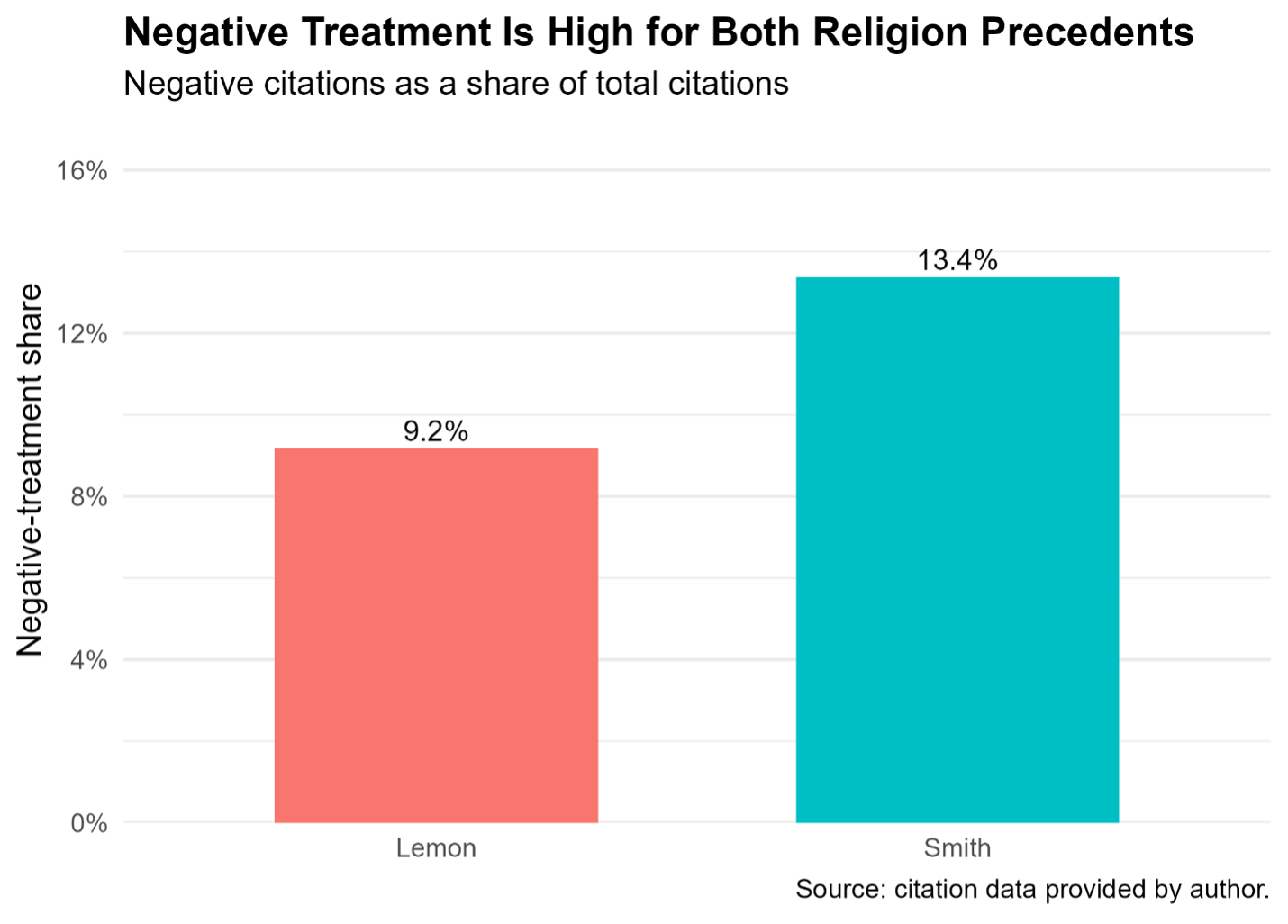
In the data, Smith has 2,901 total citations and 388 negative citations, producing a negative-treatment share of 13.4 percent. Lemon has 2,255 total citations and 207 negative citations, for a negative-treatment share of 9.2 percent. Both cases therefore show substantial doctrinal strain, though they have followed different paths.
Lemon is the clearer example of functional abandonment. The Court did not overrule it cleanly until Kennedy. Instead, it gradually displaced the test. Lemon once supplied the familiar three-part Establishment Clause inquiry: secular purpose, primary effect, and excessive entanglement.
For years, that framework structured Establishment Clause litigation, especially in lower courts.
But the Court repeatedly declined to treat Lemon as controlling. In cases involving religious symbols, legislative prayer, monuments, and longstanding public practices, the Court increasingly turned to history, tradition, and context. Lemon became less a command than a reference point. Eventually, in Kennedy , the Court said it had “long ago abandoned” Lemon and the endorsement-test offshoot.
That sequence makes a difference. Lemon did not lose authority because courts stopped citing it. It lost authority because the Supreme Court stopped using it to decide cases. The formal citation remained, but the operative method changed. By the time the Court announced abandonment, it was already visible across the doctrine.
Smith is different because it remains formally alive. The Court has not replaced it with a general strict-scrutiny rule for all burdens on religious exercise. But it has made the threshold inquiry—whether a law is truly neutral and generally applicable—more consequential.
Under Smith, a neutral and generally applicable law usually receives deferential review even when it burdens religion. Modern pressure comes from the exceptions. A law may fall outside Smith’s safe harbor if it contains individualized exemptions, targets religion, favors comparable secular conduct, or is underinclusive in a way that suggests discrimination.
That is how Smith can weaken while remaining formally controlling. The Court need not reject the rule if it repeatedly narrows the category of laws that benefit from it. Each decision finding non-neutrality, lack of general applicability, or discriminatory under inclusion reduces Smith’s practical reach.
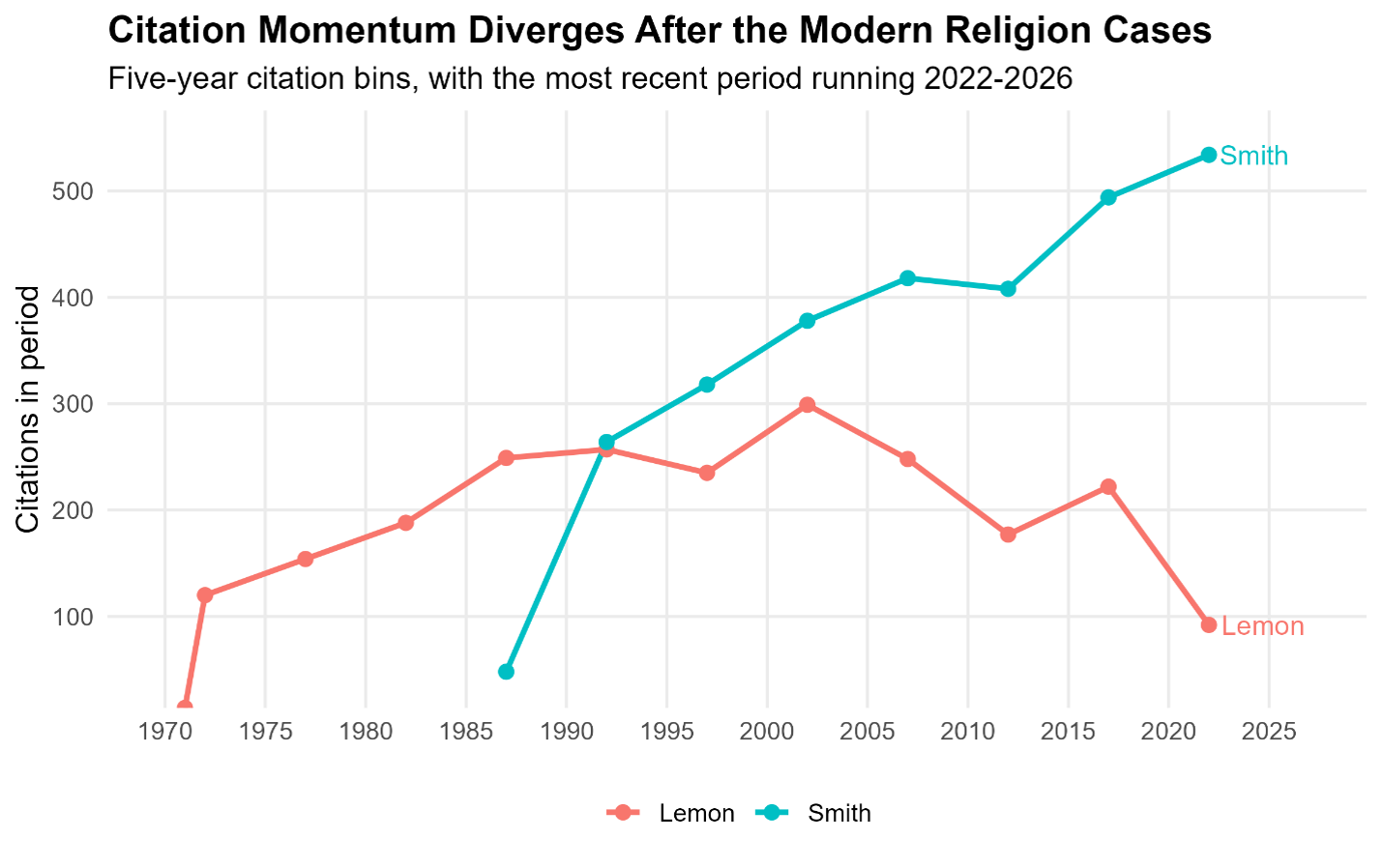
The citation trend reinforces the doctrinal distinction. Lemon’s recent citation volume has fallen after the Court’s move toward history and tradition. Smith, by contrast, remains active. Its recent citation volume reflects continuing litigation over neutrality, general applicability, religious exemptions, and the boundary between ordinary regulation and religious targeting.
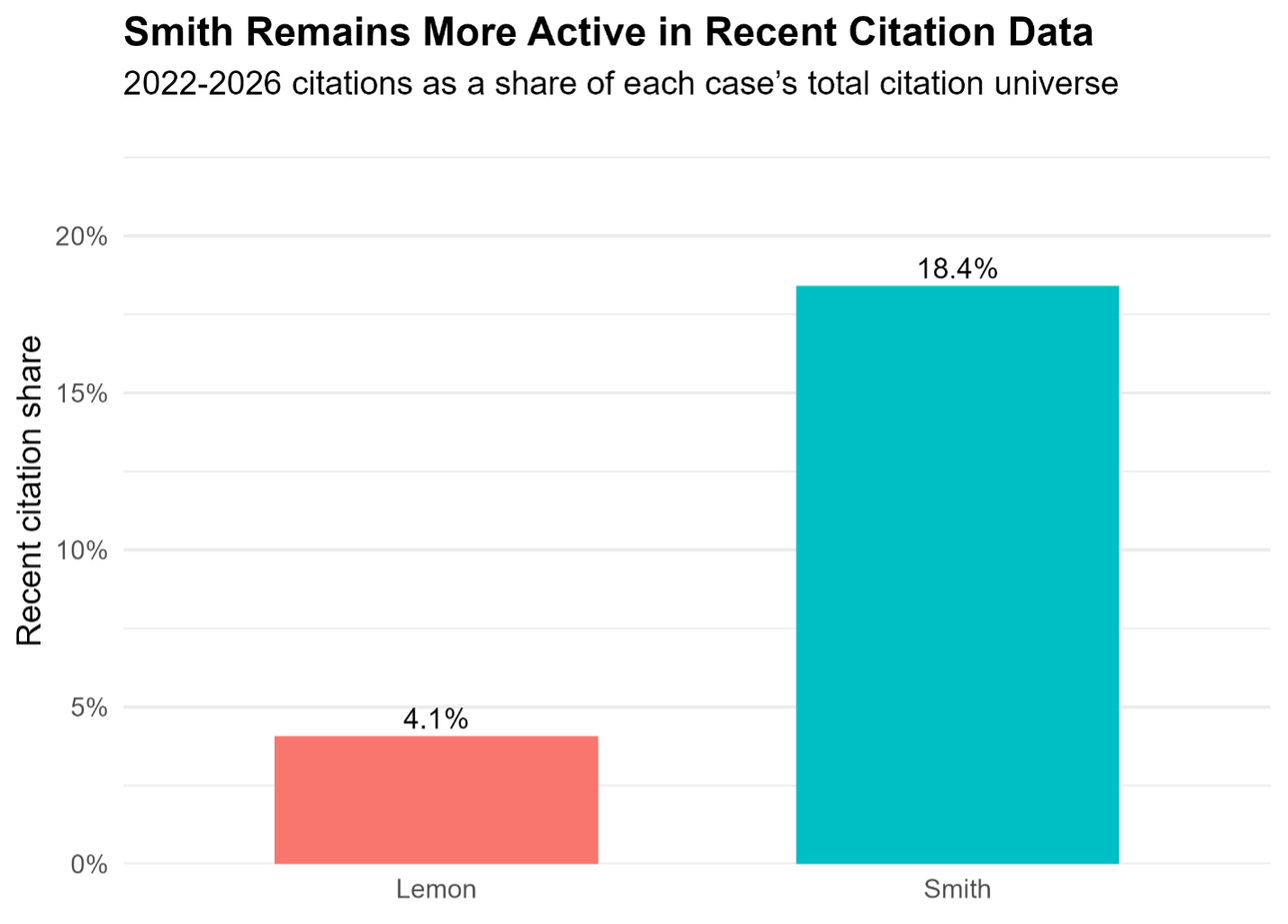
The contrast is useful. Lemon eroded through replacement: the Court moved from a three-part Establishment Clause test to history and tradition. Smith is eroding, if at all, through filtration: the Court keeps the rule but tightens the gateway into it. In Establishment Clause cases, the test changed. In Free Exercise cases, preliminary classification became decisive.
These precedents show how doctrine can change before the Court uses the word “overruled.” A case may remain formally cited while losing its practical role. It may be narrowed, translated, bypassed, or surrounded by exceptions.
That is the deeper lesson of Lemon and Smith. Formal overruling is only one way a precedent dies. Sometimes a precedent is declared abandoned after years of displacement. Sometimes it survives after the Court has reduced the territory it governs. The question is whether the precedent still does real doctrinal work.
The staying power of Smith will be further tested in the upcoming Supreme Court Term, when the justices hear St. Mary Catholic Parish v. Roy. The case asks whether lack of general applicability under Smith requires unfettered discretion or categorical exemptions for identical secular conduct, and whether Carson v. Makin displaces Smith only when the government explicitly excludes religious people or institutions.
— — —
Note: This is an edited version of Dr. Feldman’s article that originally appeared on his Substack: Legalytics. It was produced with Dr. Feldman’s consent.