by Adam Feldman, J.D., Ph.D. • 5 minutes
The U.S. Supreme Court under Chief Justice John Roberts has produced a large and varied body of First Amendment law, but one part of that jurisprudence stands out for its stability: religion. Across nearly two decades, religious-liberty claimants have prevailed at a remarkably high rate, and in recent years that pattern has become even more pronounced.
A Consistent Pattern in Religion Cases
The Court’s recent announcement to hear St. Mary Catholic Parish v. Roy highlights the point. The case concerns Catholic preschools excluded from Colorado’s universal preschool program because they adhere to Catholic teachings in admissions and related policies. The Court agreed to review questions about general applicability under Employment Division v. Smith and the relationship between Smith and its public-benefits cases. It declined to decide whether Smith should be overruled outright. That posture fits the Court’s recent approach: rather than replacing Smith directly, the Court has narrowed the set of cases in which it matters.
The outcomes reflect that shift. Before Justice Barrett joined the Court, religious claimants or religious-position parties prevailed in 10 of 12 formal religion cases, or 83 percent. Treating Zubik v. Burwell as a non-merits remand raises that figure to 10 of 11, or 91 percent. Since Barrett joined, the record is 6 for 6. Including religion-adjacent cases—cases involving religious speakers or conscience-based claims resolved through other doctrines—the Barrett-era record becomes 10 for 10.
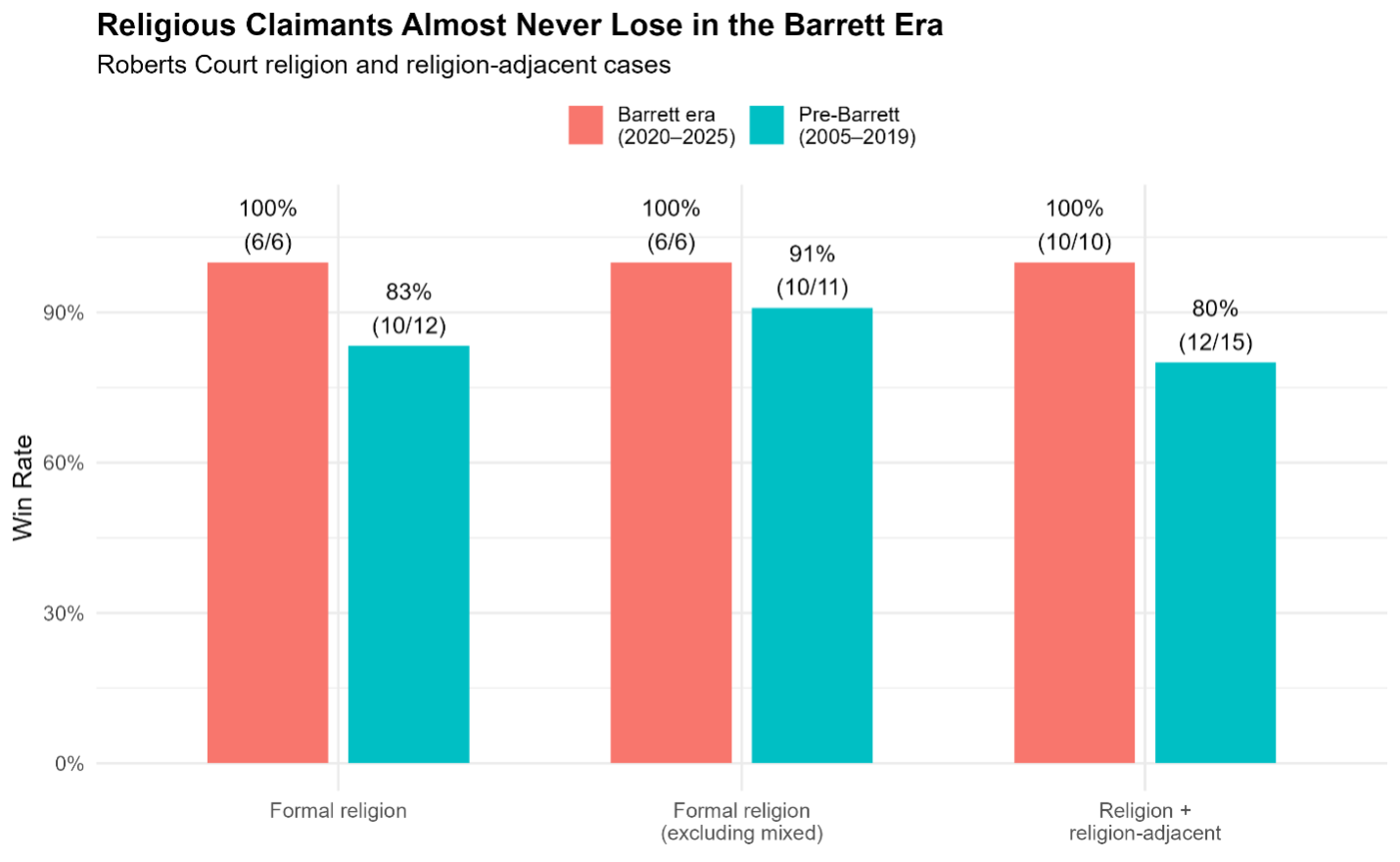
This graph shows how that change appears across time. The pre-Barrett period already reflects a strong claimant advantage, but the Barrett-era results reach complete consistency across both formal religion cases and the broader religion-related category. The shift visible in the chart matches the doctrinal trend: the Court has moved from favoring religious claimants in most cases to doing so in nearly all of them.
The Expansion of Religious Liberty Across Doctrines
The Roberts Court’s religion jurisprudence developed in stages. Early cases focused on protecting religious exercise within existing frameworks. In Gonzales v. O Centro, the Court protected sacramental religious practice under RFRA. In Hosanna-Tabor, it recognized constitutional protection for religious institutional autonomy. In Burwell v. Hobby Lobby, it extended RFRA protections to closely held corporations. In Holt v. Hobbs, it protected prisoner religious exercise under RLUIPA.
The Court then turned to public benefits. In Trinity Lutheran, it held that a church could not be excluded from a public-benefit program because of its religious status. Espinoza extended that reasoning to religious schools, and Carson v. Makin rejected attempts to distinguish between religious status and religious use. These decisions reframed what had often been described as separation of church and state as discrimination against religion.
More recent cases extend the same approach across additional settings. Tanzin v. Tanvir allows damages claims under RFRA against federal officials. Ramirez v. Collier protects religious exercise in the execution chamber. Kennedy v. Bremerton School District protects a coach’s prayer and replaces the Lemon framework with a history-and-tradition approach. Catholic Charities Bureau v. Wisconsin LIRC rejects a state’s narrow definition of religious purpose. Mahmoud v. Taylor protects parents asserting religious objections to school instruction.
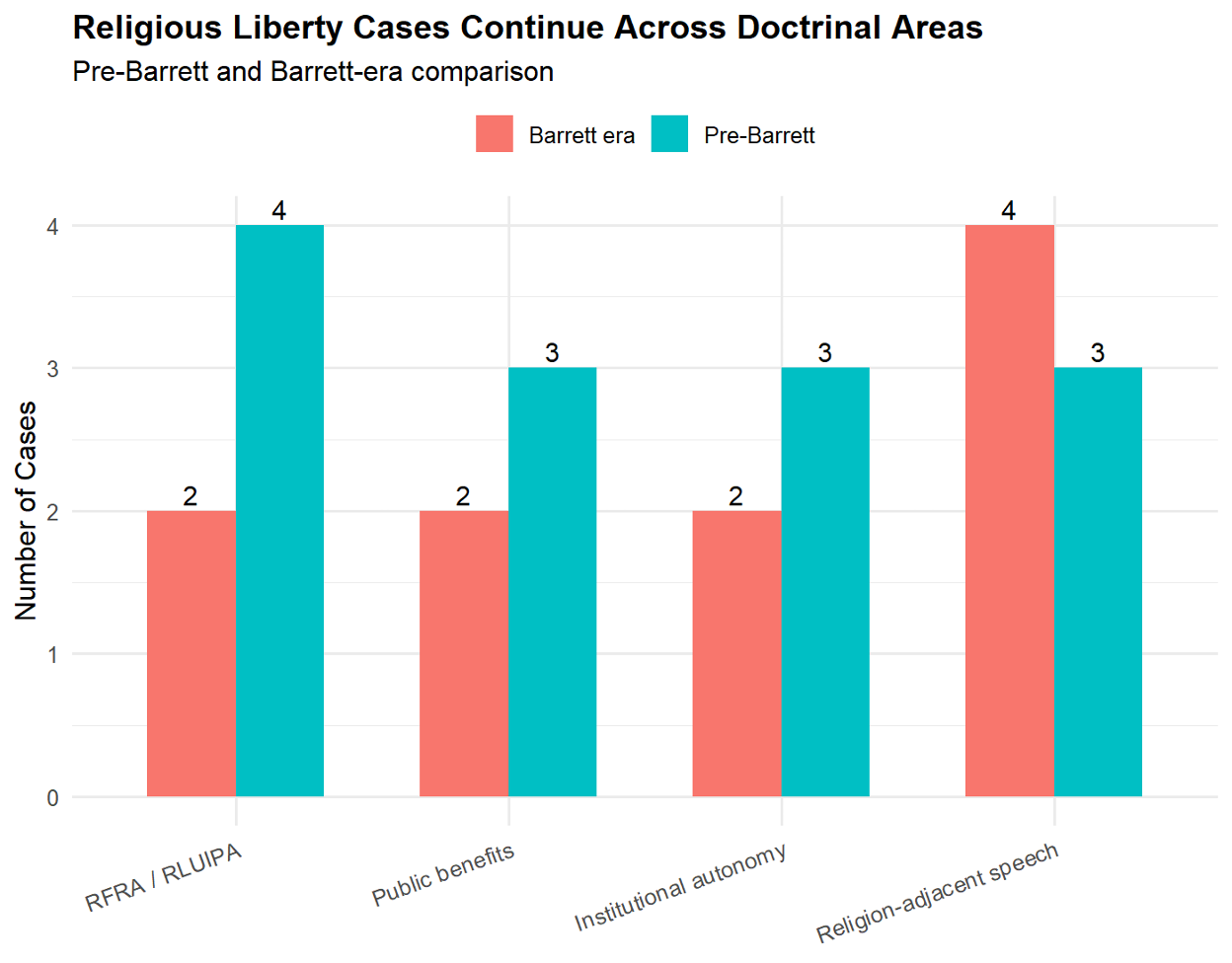
The graph above places these cases into context. It shows that the Court’s religion decisions are not concentrated in a single doctrinal category. Religious Freedom Restoration Act (RFRA) and Religious Land Use and Institutionalized Persons Act (RLUIPA) cases, public-benefits disputes, institutional-autonomy claims, and religion-adjacent cases all continue across both periods. The mix shifts somewhat over time, with religion-adjacent and public-benefits cases becoming more prominent, but the overall pattern remains stable: across each category, the Court repeatedly rules for the religious claimant.
The breadth of these categories helps explain the Court’s current posture. Religious-liberty decisions are no longer confined to a narrow set of exemption cases. They now span multiple areas of law, from employment and education to public funding and expressive activity. The result is a body of doctrine that operates across institutional settings rather than within a single doctrinal lane.
The Diminishing Role of Smith
This expansion has not depended on frequent overruling of precedent. Kennedy stands out because it replaced the Lemon framework , but most of the change has occurred through redefinition. The Court has narrowed what counts as neutrality, broadened what counts as discrimination, and reframed disputes in ways that favor religious claimants.
The same pattern appears outside the First Amendment. In Groff v. DeJoy, the Court replaced the longstanding “more than de minimis” standard for denying religious accommodations under Title VII with a more demanding test, without formally overruling precedent. In Fulton v. Philadelphia, the Court declined to overrule Smith while tightening the definition of general applicability. These decisions alter outcomes while leaving earlier doctrine formally intact.
The Court has therefore developed multiple ways to resolve religious-liberty cases without relying directly on Smith. Some cases proceed under RFRA or RLUIPA. Others turn on public-benefits doctrine, where exclusion becomes discrimination. Still others rely on institutional autonomy or are framed through speech doctrine when religious expression is involved. These overlapping approaches reduce the number of cases in which Smith is decisive.
St. Mary fits squarely within that framework. The Court could conclude that Colorado’s program is not generally applicable because of its structure or exemptions. It could treat the exclusion as discrimination against religious participation in a public benefit under Trinity Lutheran, Espinoza, and Carson. Or it could combine these approaches. Each path would leave Smith formally intact while further limiting its role.
The pattern that emerges is one of gradual transformation. Religious claims now succeed across public benefits, schools, prisons, employment, and expressive settings, and through multiple doctrinal frameworks. The Court has reshaped the categories that determine how those claims are analyzed, making it easier for religious claimants to prevail without requiring a direct confrontation with existing precedent.
St. Mary may not produce a definitive statement about Smith. It also may not be needed for doctrinal purposes. The Court has already built a body of law in which Smith occupies a smaller and more uncertain space. The case offers another opportunity to continue that process, reinforcing a trajectory that has become one of the defining features of the Roberts Court’s approach to religious liberty.
— — —
Dr. Adam Feldman holds a J.D., a Ph.D. in political science, and was a post-doctoral fellow in the study of empirical public law. He writes for SCOTUSBlog, runs the Substack: Legalytics, and is a strategic legal consultant running the company EmpiriLaw, Inc.
Note: This is an edited version of Feldman’s article that originally appeared on his Substack: Legalytics. It was published with Feldman’s consent.