Families Ask Supreme Court to End California’s Religious Discrimination
by Jorge Gomez, Director of Content Strategy
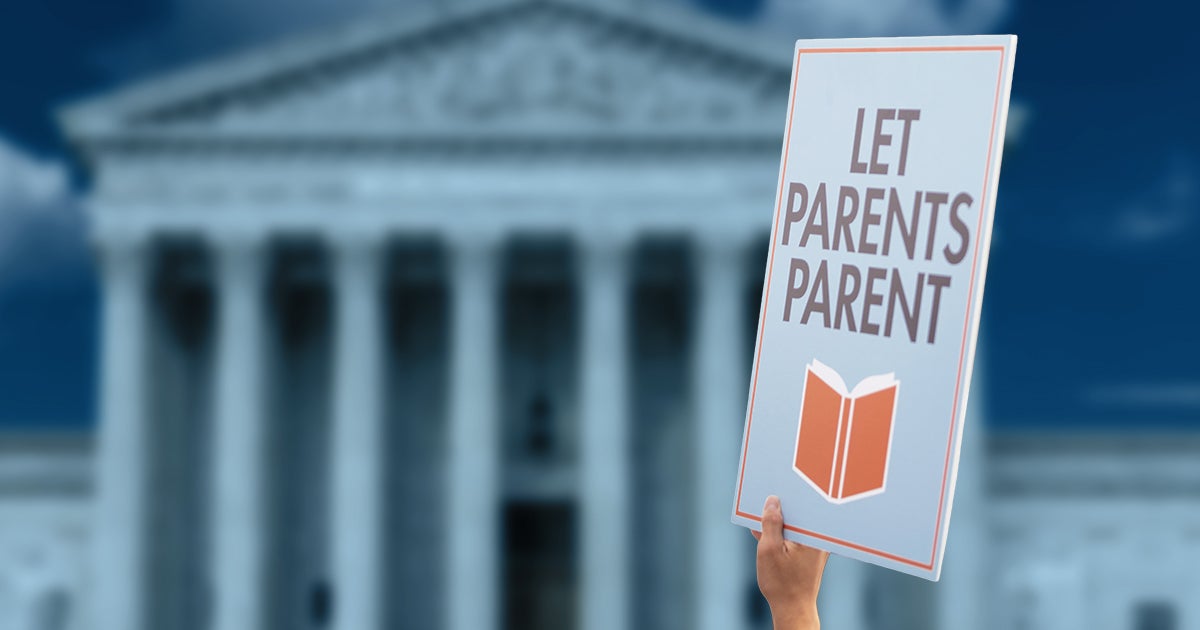
California is discriminating against families who choose a religious education. According to the state, parents who homeschool their kids cannot participate in public benefit programs if they select curriculum or purchase school materials that even mention religion or come from a religious publisher.
This week, First Liberty asked the U.S. Supreme Court to make it clear that this is unconstitutional.
The case involves three families—John and Breanna Woolard, Hector and Diana Gonzales, and Carrie Dodson—who are devout Christians and whose faith is central to who they are. All three want to ensure their children receive an education based on their religious beliefs and values. That’s why they opted to educate children completely at home, at their own kitchen tables.
California offers a program through its online charter schools in which families can access public funds to choose homeschool courses, materials, and extracurricular activities. But the state says parents can’t use a religious curriculum or materials—not even historical works by Jonathan Edwards or Easter-themed LEGO sets.
Additionally, the schools refuse to issue credit for coursework that originates from a religious curriculum or perspective. First Liberty Counsel Kayla Toney says at one point, California programs expelled the Dodsons and did not give credit to the Woolard and Gonzales children for their worksheets simply because they mentioned God or came from religious publishers.
“Parents should not be punished for choosing quality religious curriculum meeting the state’s standard that they teach to their own children in their own home just because it’s religious,” she explained.
“By denying funds for all religious curricula while simultaneously permitting all other secular material, California displays its blatant and unlawful discrimination,” she continued. “We are asking the Supreme Court to set the record straight that religious families cannot be excluded from programs like this just because of their religious beliefs.”
In Carson v. Makin, a case brought by First Liberty, the Supreme Court set a landmark precedent to protect religious families, allowing them to pursue the best educational option without government interference. The Court held that government can’t discriminate against parents who want to use state-provided funding to attend religious schools simply because those schools are religious.
Even so, California officials are ignoring the Court’s precedent and insist on singling out religious families.
Religious families should never be treated like second-class citizens, and as the Supreme Court held in our Coach Kennedy case, religious speech is doubly protected by the First Amendment. That includes parents teaching their own children in their own homes about their faith.
The Woolard, Gonzales, and Dodson families need your support now more than ever. They can’t do it alone. We’re asking you to join them in this legal battle.
These families are just like yours. Just like mine. They simply want what’s best for their kids. But the state keeps getting in their way and mistreating them.
We need support to win this case. The outcome won’t just impact three families in California. It affects virtually every family in America. This is our opportunity to potentially set a precedent that protects not only our clients, but also your family and millions of families across the country.
 Back-To-School Essentials: Your Rights as a Parent
by Kayla Toney, Counsel
With the school year starting, many parents have questions regarding their religious rights and their involvement in their children’s education.
You are the first line of defense for your family. We want to provide you with some clarity and resources, so that you’re equipped and ready.
A couple of the most frequent questions we hear are: Can I opt my children out of courses and materials that interfere with my religious beliefs? What are my rights if I don’t want my kids to be learning radical gender ideology at school?
The Supreme Court delivered a tremendous victory in favor of parental rights in Mahmoud v. Taylor. That decision held that as a parent you have the legal right to opt your children out of lessons in public schools that substantially interfere with your religious beliefs. That includes gender ideology—and other topics, too.
By law, most states already require schools to offer parental opt-outs from sex education in the context of a health unit. But parents deserve more, because curriculum and class discussions throughout the school day may burden parents’ right to direct the religious upbringing of their children.
Where the teaching would interfere with families’ religious beliefs, the Supreme Court decision in Mahmoud holds that schools must provide advance notice and opt-outs. Denying parents that right is unconstitutional.
And it’s important for you to know this protection applies to public education. Mahmoud clarified that as a public benefit, public education cannot be conditioned “on parents’ willingness to accept a burden on their religious exercise.”
In Mahmoud, the Court also said: the “government burdens the religious exercise of parents when it requires them to submit their children to instruction that poses ‘a very real threat of undermining’ the religious beliefs and practices that the parents wish to instill.”
This precedent strengthens longstanding protections for you as a parent. In fact, the Supreme Court has consistently held for at least 100 years that the First Amendment is a “charter of rights of parents to direct the religious upbringing of their children.” There are many cases that make this clear.
According to the Court’s ruling in Wisconsin v. Yoder, the Free Exercise Clause protects parents’ freedom to direct their children’s education and to impart sincere religious beliefs to them, without government interference. What’s more, the government’s interest in the education of children does not outweigh the fundamental rights of parents, especially “with respect to the religious upbringing of their children.”
In Pierce v. Society of the Sisters of the Holy Names of Jesus & Mary, the Supreme Court explained that since the “child is not the mere creature of the state,” public schools must defer to “those who nurture him and direct his destiny,” meaning parents, because they “have the right, coupled with the high duty, to recognize and prepare him for additional obligations.”
Bottom line, parents do not give up their rights when they choose to send their children to public school.
If you’re concerned that school curricula or class assignments are at odds with your religious beliefs, consider the following:
Schools are required to accommodate families’ religious beliefs regardless of whether school officials agree with or share those beliefs.
Always remember that our children do not belong to the state. You—the parent—are in charge of your children’s education and upbringing. The Constitution and decades of strong legal precedent say that you have those rights.
If you or any parent you know receive pushback from school administrators, or if you have additional questions about specific topics or school situations, please contact First Liberty and request free legal assistance.
Montana Remains One of the Best at Protecting Religious Liberty
For the third year in a row, Montana ranked among the top five at protecting religious freedom.
This year, it ranked #4 in the Religious Liberty in the States index published by First Liberty’s Center for Religion, Culture & Democracy.
Big Sky Country now protects 71% of the religious liberty safeguards tracked in the 2026 RLS index.
The state’s rise to the top has been nothing short of impressive, to say the least. In 2022, Montana was in the middle of the pack at 24th place and a score of 40%. Since then, it’s made significant improvements to better protect religious freedom for its citizens, increasing its score by more than 30 percentage points!
Montana upped its score year-over-year by adding key protections in health care, including protecting the right of therapists to opt out of counseling practices that conflict with their sincerely held religious beliefs. It also gave students more freedom to be excused from school to receive off-campus religious instruction.
Want to see where your state ranks? Check out the state rankings here.
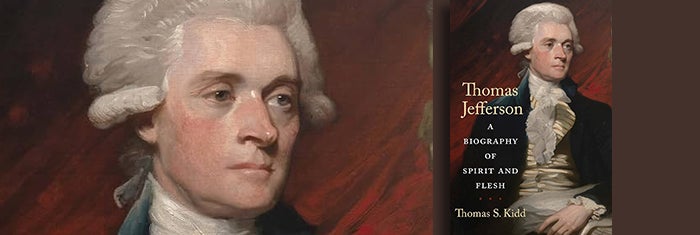 Recommended Reading | Thomas Jefferson: A Biography of Spirit and Flesh
In his book, Thomas Jefferson: a Biography of Spirit and Flesh, Thomas Kidd explores the complex spiritual life of one of the most influential Founding Fathers.
Kidd explains that Thomas Jefferson does not fit comfortably into any of the categories that many would like to place him in. He was neither the orthodox Christian some defenders of the American Founding wish him to be, nor the uncomplicated secularist many imagined.
He was the author of the Declaration of Independence who held men and women in bondage; the champion of republican virtue who lived beyond his means; the reverent admirer of Jesus who rejected many orthodox Christian beliefs. He remains, in other words, one of the most brilliant and morally vexing figures in American history.
Jefferson was not simply the secularist hero some have sometimes wished him to be. He read Scripture throughout his life, invoked religious language in public, admired Jesus as the greatest moral teacher, and defended religious liberty not because he wanted religion to disappear from public life, but because he believed true religion required freedom from coercion.
Leading The Conversation | First Liberty in the News
Cruz, Slotkin Introduce Bill to Protect Americans’ Right to Worship – President, CEO & Chief Counsel Kelly Shackelford on Texas Insider
Ted Cruz, Conservatives Respond After Talarico Criticizes Bible-related Education in Schools As ‘Propaganda’ – Executive General Counsel Hiram Sasser on Fox News
Virginia Denies Tuition Aid to Christian Student Pursuing Religious Major – Senior Counsel Jeremy Dys on CBN News
‘Perfectly In Line with Constitution:’ Right Defends Bible in Texas Public Schools After Lawsuit – Senior Counsel Roger Byron on Just The News
Court Packing Is Not ‘Reform’ – It Is a Threat to Judicial independence
by Hiram Sasser, Executive General Counsel
There is a dangerous temptation in American politics to believe that every political problem can be solved by winning one more vote. If the Supreme Court issues decisions that a political party dislikes, why not simply change the number of justices and appoint new ones? Congress has the constitutional authority to determine the size of the Court, after all. Why not use that authority?
Because the power to do something is not the same as the wisdom to do it.
Court packing would establish a precedent that could transform the Supreme Court from an independent constitutional tribunal into an institution whose membership could be manipulated whenever one political party gains sufficient power. That would be a dangerous development for Democrats, Republicans and every American who expects the Constitution to restrain government rather than simply ratify the preferences of whoever controls Washington.
The warning comes not merely from constitutional theory, but from American history. In 1937, President Franklin D. Roosevelt proposed reorganizing the federal judiciary after the Supreme Court had struck down major elements of his New Deal. His plan would have allowed him to appoint as many as six additional justices under certain circumstances, potentially changing the Court’s ideological balance.
One of the most important opponents was a Democrat from Dallas, Representative Hatton W. Sumners of Texas.
Sumners was hardly an automatic opponent of Roosevelt. He had supported most of the early New Deal, including major agricultural and industrial legislation. He had even worked on legislation concerning Supreme Court justices and retirement. But when Roosevelt proposed expanding the Court, Sumners recognized that something fundamentally different was at stake.
As chairman of the House Judiciary Committee, Sumners had enormous influence over the proposal. He decided that the bill would not come out of his committee. The Texas State Historical Association records that Sumners understood that if the bill were reported to the House, it probably would pass. Instead, he kept it bottled up while organizing opposition among members of Congress and the public.
Sumners’s position is especially instructive today because he was not simply opposing Roosevelt from the other side of the political aisle. He was a Democrat resisting a Democratic president. He was demonstrating a principle that modern Washington desperately needs: constitutional statesmanship sometimes requires politicians to defend institutions that frustrate their own political objectives.
The Supreme Court is supposed to be frustrating sometimes.
Its purpose is not to produce the preferred policy outcomes of the president, Congress or either political party. Its purpose is to interpret the Constitution and federal law. Americans can criticize particular decisions, pass legislation within constitutional limits, elect presidents who nominate different judges and, when necessary, amend the Constitution.
What they should not do is change the composition of the Supreme Court simply because they dislike the decisions being rendered by the existing Court.
Once that principle is abandoned, there is no obvious stopping point.
Imagine that one party adds four justices. The opposing party wins the presidency and Congress a few years later and adds four more. The first party returns to power and adds another five. Before long, the size of the Supreme Court becomes an election-cycle bargaining chip.
The Court would become more political precisely because politicians had deliberately made it so.
This is where Venezuela provides an important warning—not because the United States is Venezuela, but because the Venezuelan experience demonstrates how changing the structure of a nation’s highest court for political purposes can damage judicial independence.
In 2004, during the government of Hugo Chávez, Venezuela’s National Assembly changed the law governing the country’s Supreme Court and expanded it from 20 justices to 32. The new law also allowed the governing coalition to appoint new justices with a simple majority under circumstances in which existing members had required a two-thirds vote. Human Rights Watch warned at the time that the changes could enable the governing coalition to obtain an overwhelming majority on the court.
The comparison should be made carefully. The United States in 2026 is not Venezuela under Chávez. America’s Constitution, federal system, political institutions, civil society and judicial traditions are fundamentally different. Court packing in the United States would not automatically produce the Venezuelan experience.
But that distinction does not make Venezuela irrelevant. It makes the example useful as a cautionary tale.
The danger begins when political leaders convince themselves that extraordinary institutional changes are justified because the other side is dangerous, unreasonable or abusing the system. In Venezuela, supporters of the 2004 changes offered arguments about the judiciary’s workload and institutional needs.
Critics, however, warned that the practical effect was to give the governing coalition the ability to reshape the country’s highest court. Subsequent scholarship and international observers have identified the erosion of judicial independence as a major component of Venezuela’s democratic decline.
America should not wait to discover how far that road leads.
The lesson of 1937 is particularly powerful because the American system actually rejected the temptation.
Roosevelt’s proposal encountered resistance from members of his own party. Sumners kept the measure from advancing through the House Judiciary Committee, while other Texas Democrats, including Vice President John Nance Garner and Senator Tom Connally, opposed it. The Senate Judiciary Committee ultimately recommended rejection, and the full Senate defeated the proposal 70–20.
That episode should not be remembered merely as an interesting footnote from the New Deal era. It was an example of institutional self-restraint.
Sumners understood that political power has to be exercised within a larger constitutional framework. His opposition was not based on the belief that the Supreme Court was infallible. He did not have to agree with every judicial decision to believe that the Court should remain independent.
That distinction is critical.
A judge can be wrong. A Supreme Court decision can be wrong. A constitutional interpretation can be challenged. But the remedy for a bad decision should not automatically be to alter the institution so that a different political coalition can guarantee a different result.
Otherwise, every election becomes a potential constitutional crisis.
The argument for court packing often begins with a familiar refrain: The other side did it first. Or: The Court has become too political. Or: We have to restore balance.
But if the Court has become too political, making its membership more directly dependent on partisan victories is hardly the cure.
Presidents already possess enormous influence over the judiciary through legitimate appointments. Elections have consequences. When a justice retires or dies, the president nominates a successor and the Senate exercises its constitutional role of advice and consent. That process can and should be vigorously contested.
But there is a fundamental difference between filling a vacancy and manufacturing new seats because the existing Court has reached decisions a political majority dislikes.
The first is constitutional succession.
The second is institutional retaliation.
That is why Hatton Sumners’s example deserves renewed attention.
He demonstrated that a politician can recognize the difference between winning a political battle and preserving a political system. He could have viewed the Supreme Court as another battlefield in the fight over the New Deal. Instead, he treated judicial independence as a principle worth defending even when doing so meant opposing his own president and his own party.
That is the standard Americans should demand today.
If the Supreme Court issues a decision you believe is wrong, fight it. Make the constitutional argument. Pass legislation where the Constitution permits it. Elect different presidents. Confirm different judges when vacancies arise. Pursue a constitutional amendment when that is the proper remedy
But do not redesign the Supreme Court simply to guarantee that your side wins.
That road may offer a short-term political victory. But once court packing becomes an accepted weapon, every future majority inherits the weapon—and every future minority has reason to fear it.
The genius of the American constitutional system is that it does not assume today’s political majority will always be right. It creates institutions capable of saying no.
That is not a flaw to be corrected.
It is the point.
And the lesson Hatton Sumners left behind in 1937 is worth remembering: sometimes the most important act of political courage is refusing to give your own side power that you would fear in the hands of your opponents.
America should resist court packing—not because the Supreme Court is perfect, but because an independent judiciary is more important than any single Supreme Court decision.
The Court belongs to the Constitution, not to the party that happens to control Congress.
And that is a principle worth defending before it becomes a casualty of partisan victory.
Editors’ Picks | Stories Around the Nation
Hakeem Jeffries Calls for Supreme Court Overhaul If Dems Capture Midterms – Washington Times
Angry at the Supreme Court, Liberals Push a Slew of Plans for Overhauling It – The Washington Post
Church Doctrine, Not Courts, Define Confession Says Arizona Supreme Court – National Catholic Reporter
Public Schools Shouldn’t Be Fiefdoms of Government Speech – National Review
Supreme Court Asked to Block Ten Commandment Displays in Public Schools – USA Today