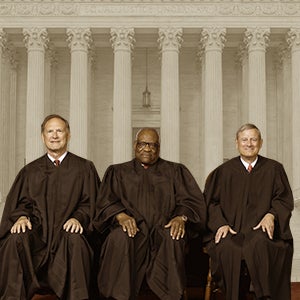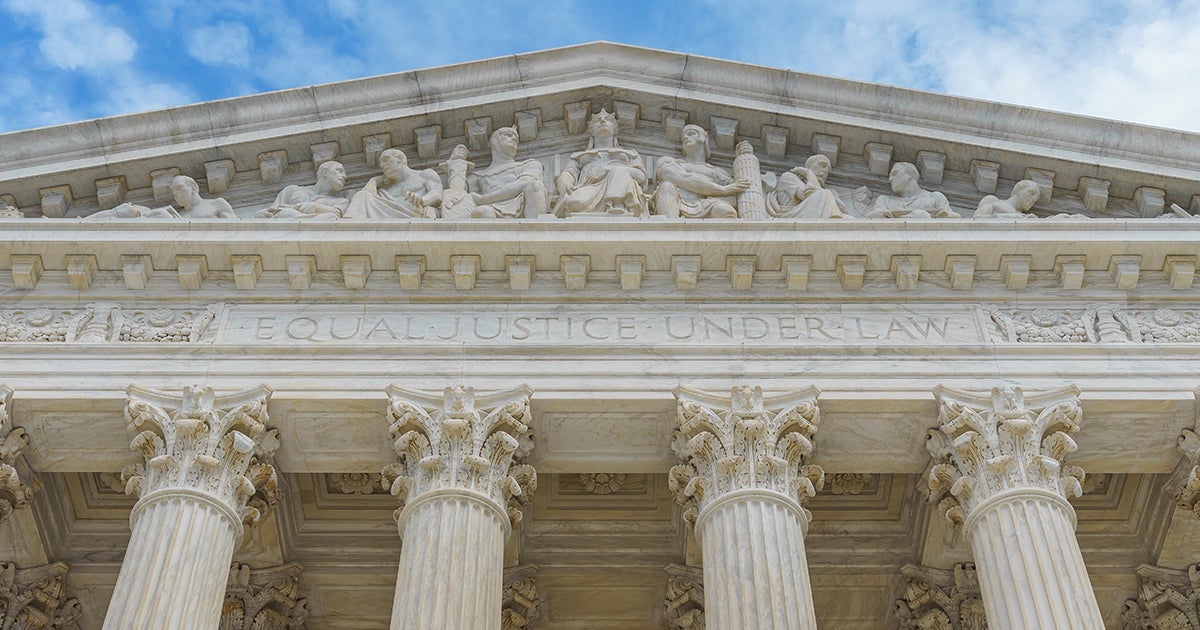
First Liberty is About to Have 6 Cases at the U.S. Supreme Court
It’s mid-July—which means the U.S. Supreme Court has wrapped up its term and won’t resume hearing cases until early October.
But, the fight for religious freedom doesn’t get a summer break.
With a Supreme Court appeal that we filed right before the July 4th holiday, First Liberty now has a total of four cases that we have asked the nation’s highest court to hear.
In addition to these cases, we have at least two more that we will appeal to the Supreme Court in the coming months.
First Liberty President & CEO Kelly Shackelford explains how these cases present a tremendous opportunity to protect religious freedom for millions of Americans.
‘Separation of Church and State’ Is Nowhere to Be Found in the Constitution
by Josh Blackman, Centennial Chair of Constitutional Law at the South Texas College of Law Houston
The Religion Clauses of the First Amendment have very few words: “Congress shall make no law respecting an establishment of religion, or prohibiting the free exercise thereof.” But look hard, and you won’t find the words “separation of Church and State.”
This phrase appears nowhere in the Constitution. Instead, it came from a private letter President Thomas Jefferson wrote to a group of Baptists in Connecticut more than a decade after the Bill of Rights was adopted.
For the first 150 years of American history, there was no separation of Church and State under the Constitution. Several states had established churches, governments routinely funded religious causes, and schools began with prayer.
Yet in 1947, the Supreme Court abandoned that tradition. In Everson v. Board of Education (1947), the Supreme Court imposed the rule of “separation of Church and State” on the American people. By a 5-4 vote, the Justices narrowly allowed the State to fund school buses for religious schools. But all nine Justices agreed that religion in public schools was unconstitutional. Fifteen years later in Engel v. Vitale (1962), the Justices prohibited public schools from opening the day by reading a prayer.
These rulings ushered in six decades of rulings that pushed people of faith out of the public square. Perhaps the most egregious ruling came in Lemon v. Kurtzman (1971), which prohibited laws that had a religious purpose or effect, or even entangled Church and State.
In short order, the Supreme Court changed our constitutional culture. Teachers, parents, and students were trained to seek out and destroy any displays of faith in public schools. Yet none of these rulings were supported by the original meaning of the Constitution.
The people chose to provide funding for religious schools and to allow prayers in public schools. The Justices had no basis to disregard those longstanding practices.
Fortunately, in Kennedy v. Bremerton School District (2022), the Supreme Court took an important step to correct the course. In this landmark case brought by First Liberty Institute, the Supreme Court recognized that the dreaded Lemon test had been “abandoned.” The Constitution permitted a football coach to pray after a game, so long as students were not “coerced” to participate. But this ruling concerned a fairly unusual set of circumstances.
The next big challenge comes from my home state. Texas required public schools to display a copy of the Ten Commandments on the wall of every classroom. Teachers and students are not required to read the Ten Commandments or say anything about them. There is simply a piece of paper posted on the wall that most people will ignore.
Yet lower courts declared this posting to be an unconstitutional form of coercion. On appeal, the Fifth Circuit reversed. Judge Stuart Kyle Duncan’s opinion for the court explained that the Texas law is consistent with a longstanding tradition of teaching about religion and morality in public schools.
An appeal is expected over the summer to the U.S. Supreme Court. The Justices will be called on to extend the Kennedy test from the football field to the classroom. This decision will allow the Court to correct a 75-year-old mistake, and declare, once and for all, that the Constitution does not separate Church and State.
— — —
Josh Blackman is a national thought leader on constitutional law and the United States Supreme Court. He also serves as a professor at the South Texas College of Law Houston. He holds the Centennial Chair of Constitutional Law.
2026 Religious Liberty in the States Index Releases on Tuesday
The 2026 Religious Liberty in the States index will be announced next week.
First Liberty’s Center for Religion, Culture and Democracy publishes a nationwide index of domestic religious freedom. It ranks religious liberty protections for each of the 50 states. The Index focuses on select legal safeguards of religious exercise in state laws and constitutions.
On Tuesday, July 14 at 10:00 am CT / 11:00 am ET, our team will announce this year’s results—and tell you which states protect religious freedom the most and which ones protect it the least.
Mark your calendar! Subscribe to our YouTube channel and get notified when we go live on Tuesday.
Ten Commandments Monuments Are Going Up Across Texas
Our precedent-setting Supreme Court wins in the Coach Kennedy and Bladensburg Peace Cross cases restored a proper understanding of the First Amendment’s Establishment Clause, paving the way for Ten Commandments monuments to be freely displayed on public property.
After Tarrant County installed one in January, and First Liberty publicly defended it, a ripple effect began spreading across Texas. On May 23, Rockwall County unveiled its monument. Amarillo installed one at City Hall on May 27.
Then, Llano County took notice. First Liberty Attorney Garrett Bell wrote a letter offering to represent the county if sued over its proposed display. As a result, the county commission voted 5-0 to install a monument.
By advocating for communities in Texas and beyond that want to install Ten Commandments monuments, we’re defending the freedom that defines America.
Leading The Conversation | First Liberty in the News
Podcast | America 250 Celebrates Civics Education – President and CEO Kelly Shackelford on Center Square
Supreme Court Asked to Hear Brackenridge Park Sacred Site Dispute with Lipan Native American Church – Senior Counsel Stephanie Taub on Texas Public Radio
America’s Two Constitutions– Center for Religion, Culture & Democracy Executive Director Jordan Ballor on Public Discourse
A Republic of Virtue– Center for Religion, Culture & Democracy Senior Fellow John D. Wilsey on WORLD Opinions
Why Do We Celebrate Independence Day?– Center for Religion, Culture & Democracy Senior Fellow Wilfred McClay on WORLD Opinions
Court Packing Should Be DOA – Center for Religion, Culture & Democracy Senior Fellow Hunter Baker on WORLD Opinions
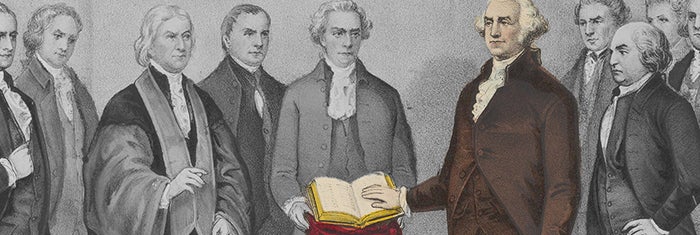
Faith on Display: Inaugural Traditions in American History
by Amelia Metz, First Liberty Intern
On January 20, 2017, my seventh-grade classmates and I sat in old red theater seats in the school’s auditorium. It was a Friday, and we were excited to be out of the classroom. Any event — even one as boring as watching a presidential inauguration — was better than doing Punnett squares.
But we didn’t realize then how much watching President Donald Trump take the oath of office would shape our educational experience.
Like many students across America, we first encountered the presidential inauguration in the classroom. It taught us about the peaceful transfer of power and the role religious traditions play in inaugural ceremonies.
If you look closely, you’ll most likely see the president’s hand on a Bible. At President Trump’s inauguration in 2017 (and in 2025), he placed his hand on his childhood Bible and the Bible that Abraham Lincoln used at his ceremony. You also may hear them add the words “So help me, God” to the end of their oath.
But neither of these traditions — swearing on the Bible or “So help me God” — are required by the Constitution. It is a tradition started by George Washington and followed by the majority of his successors.
The tradition actually has quite humble beginnings, sparked by a small last-minute detail at the first presidential inauguration.
George Washington’s 1789 inauguration had been carefully planned with one important detail missing: a Bible for him to place his hand on while taking the oath.
Jacob Morton, the parade marshal and master of the nearby Masonic Lodge, ran back and borrowed its Bible — a 1767 King James Version printed in London — for the ceremony.
After taking the oath of office, Washington kissed the Bible, which was turned to Genesis 49.
He set the precedent of fearlessly including faith in the ceremony — a precedent that would leave a lasting impression. Four presidents after him decided to place their hand on the same Bible: Warren Harding, Dwight Eisenhower, Jimmy Carter, and George H.W. Bush.
In 1921, Warren Harding was the first president to use the Washington Bible. After 132 years, what happened? Why did it take so long for another president to use that Bible?
The borrowed Bible never made its way into the hands of the government. After the ceremony, it was returned to the lodge. To this day, the lodge still owns the original Bible.
In the meantime, many other presidents have used a family Bible.
There have only been a handful of presidents who opted out of using a Bible. John Quincy Adams swore on a constitutional law book. Theodore Roosevelt didn’t use a book at all because he was quickly sworn in at his home after President William McKinley was assassinated. Lyndon B. Johnson used a Catholic missal, thinking he was using a Bible.
But there has yet to be a president who has sworn on a non-Christian religious text. That detail speaks to the original presence — and long-lasting tradition — of the Judeo-Christian values in American politics and government. Presidents aren’t expected to leave their faith at the door — it’s something that’s right there with them from the very first moment of their presidency.
There is a difference between government speech and a government official who is speaking. The Free Exercise Clause in the First Amendment protects your right to practice any or no religion at all. It does not, however, extend to protecting anyone from simply hearing another person’s faith being expressed.
Swearing on something greater than yourself creates a form of accountability that goes beyond what any person or institution alone can provide. It’s the same concept we see in the courtroom. For centuries, placing your hand on a Bible has been a way of acknowledging that you answer to a power higher than human authority.
For the president, that weight is no different. Not only are they held accountable by the American people — they’re held accountable by God.
As we celebrate America’s 250th birthday, it’s worth recognizing that this tradition stretches far beyond 250 years. Faith has been woven into the fabric of who we are as a nation since our founding — and, in many ways, since the beginning of time itself.
Editors’ Picks | Stories Around the Nation
Opinion: The Declaration of Independence Set the Stage for Religious Freedom – Deseret News
Opinion: America’s Next 250 Years Depend on Passing Faith and Freedom to Our Children – Fox News
Half of Americans Support Placing Ten Commandments in Public Schools, Survey Says – Dallas Morning News
The Left’s Supreme Court Panic Collapses Under the Weight of the Facts – Fox News
Toward a More Perfect Union – The Pillar
Everyone Should Take Religious Freedom Seriously – Deseret News