Christian Organization Banned from Building Sacred Shrine
Asks Supreme Court to Hear Its Case
A Christian organization in Park Hills, Kentucky is currently banned from using its property to build a sacred space in honor of the Virgin Mary. On Wednesday, First Liberty filed a petition at the U.S. Supreme Court on behalf of Missionaries of St. John the Baptist, Inc.
We’re asking the nation’s court to reverse a decision by the Kentucky Supreme Court that bars the construction of a modest grotto.
In Catholic tradition, a grotto is a sacred, cave-like shrine used to honor the Virgin Mary or saints. It serves as a quiet space for prayer, reflection and devotion. These structures can be found in churches, gardens or even as roadside shrines, creating a focal point for faith and spiritual solace.
In March 2021, Missionaries of St. John the Baptist applied for a conditional use permit and variance to build a dedicated space in remembrance of the Virgin Mary’s apparition in Lourdes, France to Saint Bernadette. The Park Hills Board of Adjustment approved St. John’s permit a month later.
Two neighbors adjacent to the property appealed the Board’s decision in state court. The trial court rejected the neighbors’ objections, but the Kentucky Court of Appeals reversed that decision, holding a ban of the grotto did not violate the Religious Land Use and Institutionalized Persons Act (RLUIPA). The Kentucky Supreme Court affirmed the appeals court ruling.
We argue that banning a Christian organization from using its property to carry out its mission violates federal law.
Congress passed RLUIPA to protect houses of worship from discrimination. That federal statute protects their right to operate free from unreasonable and intrusive government interference. That includes a house of worship’s right to use its facilities for religious purposes, as well as a right to be treated fairly and equally to businesses or other secular organizations.
“Intolerant neighbors should not be permitted to wield local zoning laws as a heckler’s veto to oppose cherished traditions,” said Ryan Gardner, Senior Counsel at First Liberty. “Federal law provides clear protections for how faith-based organizations can use their property to support their mission, but courts have weakened and confused that promise. We hope the Supreme Court takes this opportunity to bring much needed clarity over the interpretation of RLUIPA.”.”
If the Kentucky Supreme Court ruling stands, it will prevent countless congregations in the Bluegrass State from fulfilling their divinely inspired calling. Not only is that illegal, but it also goes against everything religious freedom in America is about.
This case presents an opportunity for the Supreme Court to affirm the federal law that protects religious institutions. The outcome could set a precedent that strengthens protections for houses of worship across America.
Religious Liberty Commission Hears from Healthcare Workers
Facing Religious Liberty Threats
On Monday, the President’s Religious Liberty Commission heard testimony from First Liberty client Valerie Kloosterman, who was fired by University of Michigan Health after 17 years of excellent patient care. She shared the emotional story of her termination and the need to protect others from religious discrimination.
Valerie is the third generation in her family to work in her local health care system. She was committed to giving the best possible care to all her patients and treated them all respectfully.
But after University of Michigan Health acquired her clinic, they demanded she affirm statements about gender that violated her religious beliefs. When she asked for a religious accommodation, she was fired. We’re fighting her case in federal district court.
In her testimony, Valerie said, “I’m praying that God would use my case to protect religious liberty for my children and for the next generation so they can freely live out their faith in the workplace.”
Bath & Body Works Settles Discrimination Lawsuit
With Former Store Manager
We are happy to announce a favorable settlement for our client, Jocelyn Boden. She was fired by Bath & Body Works for refusing to use pronouns in a way that violated her religious beliefs.
Jocelyn was a store manager in Utah for three-and-a-half years. In April 2025, she hired an employee who identified as transgender. Jocelyn’s religious convictions influence how she thinks about human nature, gender, sexuality and social issues. Jocelyn and the new employee worked together only one day. After Jocelyn refused to use male pronouns because of her religious and moral convictions, a complaint was filed with human resources accusing her of “misgendering.” She was fired the next month.
First Liberty filed a charge of discrimination with the U.S. Equal Employment Opportunity Commission last July.
“Employers cannot force you to personally affirm a radical ideology that goes against your religious beliefs,” said Stephanie Taub, Senior Counsel for First Liberty. “We are glad to have reached an amicable resolution with Bath & Body Works.”
Thank you for supporting First Liberty. Reaching this settlement would not have been possible without you. If you want to continue to support religious Americans who are being punished in the workplace, like Jocelyn, please give to First Liberty today.
Leading The Conversation | First Liberty in the News
Video: Weekend Edition with Kerby Anderson – President & CEO Kelly Shackelford on Point of View
Interview: The Upside-Down Kingdom of Jesus of Nazareth – Center for Religion, Culture & Democracy Executive Director Jordan Ballor in Acton Institute
Podcast: The Return of Christian Nationalism? – Center for Religion, Culture & Democracy Senior Research Fellow Mark David Hall in Tim Talks Politics
Council Approves Ten Commandments Monument for City Hall Grounds – Amarillo Globe-News
Religious Liberty Commission Hears Testimony From Healthcare Workers – The Daily Citizen
Celebrating James Madison:
Champion of Religious Freedom & Conscience Rights
by Jayla Ward, Digital Content Specialist
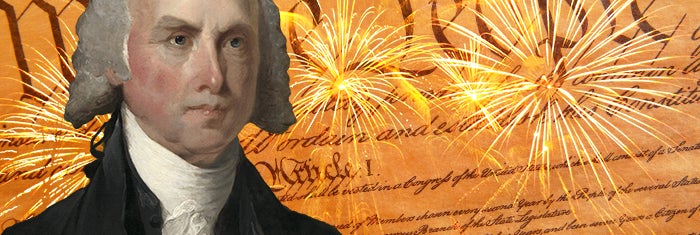
On March 16, we celebrated James Madison’s birthday. His role as the major architect of the U.S. Constitution and Bill of Rights cannot be overstated.
Throughout our history, many scholars have called him the “Father of the Constitution,” and with good reason. When the Constitutional Convention began in 1787, no other delegate was better prepared than Madison. He’d already spent years studying and refining concepts of government. His proposals were the working model used by the Convention delegates, and his writings (namely those in the Federalist Papers) were central in the ratification of our country’s founding document.
However, many do not know that his deep passion to protect religious minorities is what inspired his most important contributions.
James Madison was born March 16, 1751 in Virginia to a wealthy family of plantation owners. Like many Virginia families at the time, they attended the Anglican Church. Growing up, he witnessed the arrest and persecution of Baptist preachers and followers in his hometown.
Religious intolerance was common in Virginia at that time. Before the American Revolution, many Baptists and Presbyterians were fined and jailed for preaching without a license. Other religious groups were also punished for practicing their faith or dissenting from the commonly held religious beliefs of the time.
At the young age of 23, Madison found the actions of the authorities disturbing and began to work on how to solve the issue. He wrote a letter to his friend William Bradford, expressing his distress about the persecution of “these well-meaning men (who) were in jail for publishing their religious sentiments.”
Madison voiced his concern, asking Bradford, “Is an Ecclesiastical Establishment absolutely necessary to support civil society in a supreme Government? & how far it is hurtful to a dependent State?” Simply put, at what point does enforcing established religion infringe upon the personal liberties and conscience of others? And does it truly benefit society?
Madison’s encounters with religious persecution kickstarted his education and career. He focused his efforts on securing protections for personal religious convictions and ensuring freedom instead of compulsion.
In 1776, Madison worked on an important foundational document known as the Virginia Declaration of Rights, a model for the U.S. Bill of Rights that would come years later. Madison proposed a small but profound change in the wording, which originally called for the “toleration” of religion. That seemingly harmless phrase essentially implied there was one state-approved religion, and government would merely put up with others.
Madison wanted the toleration phrasing taken out, arguing that “all men are equally entitled to enjoy the freedom of exercise of religion, according to the dictates of conscience.” In the end, Madison succeeded and inserted the phrase “free exercise of religion,” which truly protected the right of an individual to follow his conscience.
His efforts didn’t stop there. In 1786, Madison’s political savvy and effective negotiation helped him succeed at ratifying the Virginia Statute of Religious Freedom, an important document Jefferson had written years earlier designed to protect religious liberty.
Three years later, as part of the battle to ratify the Constitution by the 13 colonies, Madison drafted the Bill of Rights, including what was to become the First Amendment. In fact, Madison’s original draft included an ambitious protection of religious liberty, which stated, “The civil rights of none shall be abridged on account of religious belief or worship…nor shall the full and equal rights of conscience be in any manner, or on any pretext, infringed.”
Congress largely relied on Madison’s original draft, and the states subsequently ratified two principles — “no establishment” and “free exercise” — that protect religious freedom as a fundamental, inalienable right for every person.
The final version that we know today—”Congress shall make no law respecting an establishment of religion, or prohibiting the free exercise thereof”— clearly bears Madison’s stamp.
In addition to his passion for religious liberty, Madison underscored that “conscience is the most sacred of all property.” Because religious rights were central to Madison’s worldview, he saw the inherent link between freedom of conscience and freedom of religion.
Madison was convinced that keeping government out of the affairs of the Church was the only way people could follow the dictates of their conscience. He viewed established state religion as a denial of the fundamental, God-given right of conscience.
Due to this, he concluded that the institution of the Church should be separate from the State and not directed by the government in any way, a principle that was enshrined in his original draft of the First Amendment.
As America nears its 250th anniversary of independence, we honor and celebrate Madison’s enduring legacy and his lifelong efforts to ensure citizens have the right to live according to their deepest convictions without government interference. Through his work, he paved the way for every American to freely and openly live out their faith.
Editors’ Picks | Stories Around the Nation
Mike Johnson Raises Concerns Over Sharia Law in U.S., Calls It ‘Serious Issue’ – Christianity Daily
Pope Leo to receive Liberty Medal from National Constitution Center on Eve of US 250th – National Catholic Reporter
Moody Bible Institute Wins Religious Freedom Case for Student Teachers – The Daily Citizen
Attack On Synagogue Is Assault on Religious Freedom, Conference of Presidents Heads Say – Jewish News Syndicate
Oklahoma Board Again Rejects Jewish Charter School But Vows to Support It in Court – Oklahoma Voice
5 Facts About Buddhists in the United States – Pew Research Center


 |
|

|